


How Much Does Septic Tank Pumping Cost in Bradenton FL? (2026 Guide)
Nobody wants to think about their septic tank.
I completely understand that. It’s underground, out of sight, and as long as everything’s working, it’s the last thing on your mind. But here’s the thing about septic systems — they don’t give you a lot of warning before they become very, very hard to ignore.
That slow drain. That faint odor near the yard. That slightly soggy patch of grass that keeps coming back. Those are your system trying to get your attention before things get ugly.
This guide is for Bradenton homeowners who want straight answers on what septic tank pumping actually costs in 2026 — not a vague range that leaves you more confused than when you started. I’ll walk you through the real numbers, what drives costs up or down, how to know if you need pumping, and what to expect when you hire someone.
And if you’re already past the “just want information” stage and into the “this needs to happen soon” territory, Redemption Plumbing Services handles septic tank services in Bradenton and can give you a straight answer on what your specific situation will cost.
What You Need to Know Before We Talk Numbers
A couple of things worth understanding before we get into prices, because context makes the numbers make more sense.
What septic pumping actually is: Your septic tank collects all the wastewater from your home. Solids settle to the bottom as sludge; lighter stuff floats as scum; and the middle layer (liquid effluent) flows out to the drain field. Pumping removes the accumulated sludge and scum before they build up enough to cause problems — overflow, drain field damage, or sewage backing up into your home.
Why it can’t be skipped indefinitely: A lot of homeowners treat pumping as something to do when a problem shows up. That’s backwards. By the time you have a real problem — sewage smell in the yard, backups in the house, soggy drain field — you’re often past the point of simple pumping and into repair territory. Pumping as prevention is dramatically cheaper than pumping as crisis response.
How often does it need to happen? Most septic professionals say every 3–5 years for an average household. But that depends heavily on tank size and how many people are in the home. A 1,000-gallon tank serving four people fills up faster than the same tank serving one. We’ll come back to this.
What Does Septic Tank Pumping Cost in Bradenton in 2026?
Let’s get to it. Here are the real numbers.
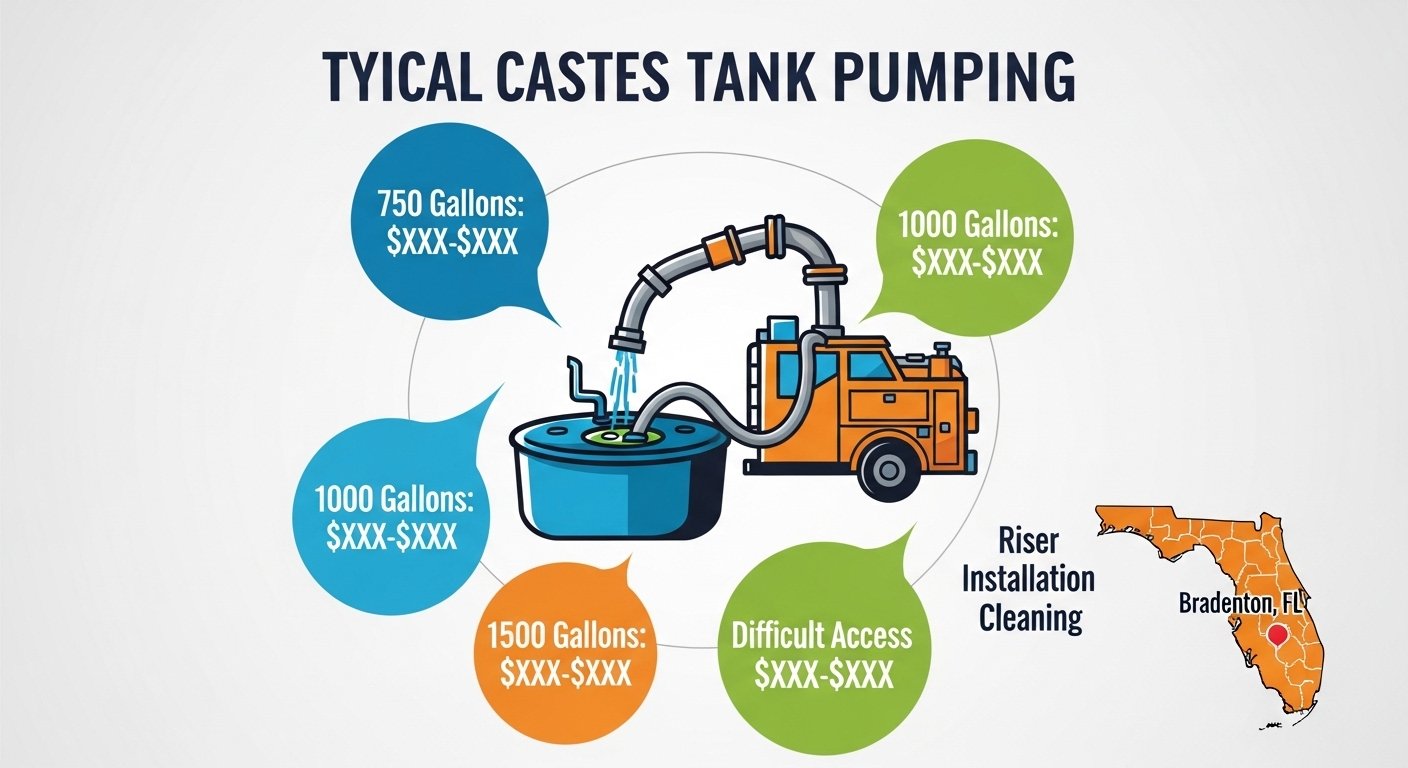
Typical range for standard septic pumping in Bradenton: $300–$600
That’s your baseline for a straightforward pump-out on a standard residential tank — usually 1,000 to 1,500 gallons — with accessible access points and no complications.
Where you might land on that range:
| Tank Size | Estimated Cost |
|---|---|
| Up to 750 gallons | $275–$375 |
| 1,000 gallons | $325–$450 |
| 1,250 gallons | $375–$500 |
| 1,500 gallons | $425–$550 |
| 2,000+ gallons | $550–$800+ |
These are ballpark figures for Bradenton and the broader Manatee County area. Your specific quote will depend on factors I’ll cover in the next section.
Emergency or after-hours pumping: Add $100–$250 to whatever the standard rate is. Emergencies cost more — that’s just reality. Another reason not to wait until it’s urgent.
Inspection add-ons: Some companies include a basic inspection with pumping. Others charge separately. A basic visual inspection might add $50–$100. A camera inspection of your drain field or pipes is a different thing entirely — those run $200–$400 and are typically only needed if there’s a suspected problem.
What Makes Your Cost Higher (or Lower)
This is the part that actually explains why two homeowners with seemingly similar setups get very different quotes.
Tank Size
Bigger tank = more to remove = higher cost. This is the most straightforward variable. If you don’t know your tank size, your permit records (available through Manatee County) should show it. So should any documentation from when your home was built or when the system was last inspected.
Access and Dig-Up Fees
Your septic tank has one or more lids that need to be uncovered for pumping. If those lids are already at or near the surface — great, easy access, no extra charge. But a lot of older Bradenton homes have tanks buried 12 to 18 inches underground, with no risers installed.
In that case, the technician has to dig to access the lid. That typically adds $50–$150 per lid, and most tanks have two. Installing risers (concrete or plastic extensions that bring the lid to ground level for future easy access) runs $200–$500, but it’s a one-time cost that pays for itself over time. Highly recommend it if your lids are buried.
How Long Since the Last Pump-Out
If your tank hasn’t been pumped in 10 years, there’s significantly more buildup than if it was done three years ago. More material to remove can mean more time, and some companies charge by volume rather than a flat rate. It can also mean discovering that the sludge layer has gotten thick enough to cause stress on the drain field.
Travel and Location
Companies servicing rural or far-outlying areas sometimes add trip fees. Most of Bradenton proper falls within standard service zones for local providers, but if you’re on the edges of Manatee County, it’s worth asking.
Condition of the System
This is where “pumping cost” can turn into “pumping plus repair cost.” If a technician spots a cracked baffle, a broken lid, effluent in places it shouldn’t be, or signs of drain field stress during the pumping visit — you might be looking at additional work. Those conversations aren’t fun, but discovering a problem early is far better than discovering it after your drain field is saturated.
Step-by-Step: What the Pumping Process Actually Looks Like
If you’ve never had your septic pumped before, it can feel a little mysterious. Here’s what a typical appointment looks like from start to finish.
Step 1: Locating and accessing the tank
The technician finds the tank (you may need to know roughly where it is) and either uncovers the existing lids or digs to access them. If you have multiple access points — most tanks have an inlet and outlet baffle — both should be opened for a thorough job.
[IMAGE: Diagram showing typical septic tank layout with inlet baffle, outlet baffle, sludge layer, and effluent layer labeled]
Step 2: Pumping the contents
A large vacuum hose goes into the tank and removes the accumulated sludge and scum. A good technician will also break up and remove floating scum, which can be harder to pull out. This typically takes 20–45 minutes depending on tank size and fullness.
Step 3: Inspection during pumping
While the tank is being emptied, a reputable technician will check the condition of the baffles (inlet and outlet), look for cracks or signs of structural issues, and check that the effluent is flowing properly. This is your opportunity to ask questions — a good tech will tell you what they’re seeing.
Step 4: Cleanup and reporting
The lids go back on, the area is cleaned up, and you should receive some kind of documentation of what was done, when, and anything they observed. Keep this record. Some counties require maintenance documentation, and it’s useful for future service calls.
Step 5: Following up on any issues
If the technician flagged anything — a cracked baffle, high solids levels, signs of drain field stress — this is when you decide how to handle it. Get a second opinion if you want, but don’t just ignore it.
How to Know If You Actually Need Pumping Right Now
Maybe you’re not sure where you stand. Here’s a quick way to think about it.
You’re probably due for pumping if:
- It’s been more than 3–5 years since the last service (or you genuinely don’t know when it was last done)
- You’ve noticed slow drains throughout the house — not just one fixture
- There’s a sewage odor near your yard or coming from drains
- You have a wet or unusually lush patch of grass over the drain field
- You recently had a significant increase in household occupancy
You likely have a more urgent situation if:
- Sewage is backing up into your home
- The odor is strong and persistent
- Standing water or obvious sewage surfacing near the tank or drain field
For the second category, don’t wait. That’s genuinely an emergency septic situation in Bradenton and should be treated like one.
Troubleshooting: When Pumping Doesn’t Solve the Problem
Sometimes a homeowner gets their tank pumped and… the drains are still slow. Or the smell comes back within a few weeks. Or the drain field is still soggy.
Here’s what might be going on:
Drain field saturation: If your drain field has been receiving partially-treated or excessive effluent for a while, the soil can become saturated and lose its ability to absorb. Pumping removes what’s in the tank, but it doesn’t repair a compromised drain field. This is more serious — and more expensive to address. Rest periods for the drain field, sometimes combined with bacterial additives, can help in mild cases. Severe saturation may require repair or replacement.
Broken or collapsed pipe: If a line between the house and tank, or the tank and drain field, is damaged, pumping won’t fix the flow problem. A camera inspection can find this.
Baffles in bad shape: The baffles direct flow in and out of the tank properly. If they’re broken or missing, solids can reach the drain field even with a freshly pumped tank. This is a relatively straightforward fix if caught early.
System sized wrong for the household: If a system was designed for a 2-bedroom home and now a family of six is living there, the tank fills faster than it can process. The math just doesn’t work long-term. More frequent pumping is the band-aid; upsizing is the real fix.
Expert Tips That Actually Matter
Get on a schedule and stick to it. Pick a pumping interval that makes sense for your household size and tank capacity, set a calendar reminder, and treat it like an oil change. It’s not exciting. It’s just maintenance.
Ask about risers when you get pumped. If your technician has to dig every time they service your tank, you’re paying extra every single service call. Risers pay for themselves.
Watch what goes down the drain. “Flushable” wipes aren’t really flushable for septic systems. Neither is grease, medications, or excessive bleach. These disrupt the bacterial balance your septic system depends on to process waste. A healthy tank has billions of bacteria doing work. Killing them off creates problems.
Keep records. Date of service, name of company, tank size confirmed, anything noted during inspection. This is useful if you sell the home, if you need warranty work, or if a new technician needs to understand the system’s history.
Don’t drive over the drain field. Or park on it. Or plant trees near it. Heavy vehicles compact the soil; tree roots seek out moisture and will find your pipes.
What to Ask When You Call for a Quote
When you’re ready to call — whether that’s scheduling routine septic pumping in Bradenton or dealing with something more urgent — here are the questions worth asking:
- Is the price a flat rate or does it vary by tank volume?
- Does the price include accessing buried lids, or is that extra?
- Do you do a basic inspection as part of the service?
- What documentation will I receive?
- What if you find something that needs repair during the visit?
A company that answers these questions clearly and doesn’t dodge the pricing details is one you can trust. Vague answers to direct questions are a yellow flag.
Summary: The Short Version
Here’s what you actually need to know:
- Typical cost in Bradenton (2026): $300–$600 for a standard residential tank
- Main cost variables: Tank size, buried lids, time since last service, any repairs needed
- How often to pump: Every 3–5 years for most households
- Signs you need it now: Slow drains, odors, soggy drain field, or it’s been over 5 years
- Don’t skip it: Pumping as maintenance is far cheaper than pumping as emergency repair
Your septic system is doing a job every single day. A little attention every few years is all it asks in return. If you’re overdue — or you’re just not sure — reaching out to a local septic service provider in Bradenton for an honest assessment is the right move. No drama, no hard sell. Just knowing where you stand is worth it.


Comments are closed