


Should You Get a Sewer Camera Inspection When Buying a Home in Bradenton FL?
You’re in the middle of buying a home. There are inspections happening, forms to sign, negotiations over the dishwasher that’s apparently “staying with the house,” and somewhere in the back of your mind you’re just hoping nothing catastrophic comes up that blows the deal.
Here’s the thing nobody tells you clearly enough: a standard home inspection does not include your sewer line. Not the underground pipe that carries everything out of the house. Not the drain field if the home is on septic. Not the connection between the house and the street.
That pipe — the main sewer lateral — can have tree root intrusion, cracked sections, collapsed spots, or decades of mineral buildup, and a home inspector will walk right past it. Because they can’t see it. It’s underground.
A sewer camera inspection is the only way to actually know what’s down there. And in Bradenton specifically, where older homes are common, tree roots are aggressive, and a meaningful portion of properties run on septic systems, this inspection earns its cost over and over again.
If you’re buying a home here and you’re on the fence about it — this article is for you. I want to give you the real reasons it matters, not a generic checklist.
7 Reasons You Should Get a Sewer Camera Inspection Before Closing
1. A Standard Home Inspection Literally Cannot See Underground
This is the foundational thing, and it’s worth sitting with for a second.
Home inspectors are thorough professionals who check hundreds of items in a few hours — roof, electrical, HVAC, foundation, windows, appliances. They’re doing a lot of important work. But they’re working from what’s visible and accessible. The main sewer line runs underground, outside the house, and they have no way to assess its condition.
So you can have a home inspector give a house a clean bill of health and hand back a report that says nothing about the pipe that’s going to cost you $8,000 to replace six months after you move in. Not because the inspector missed something — because they physically couldn’t see it.
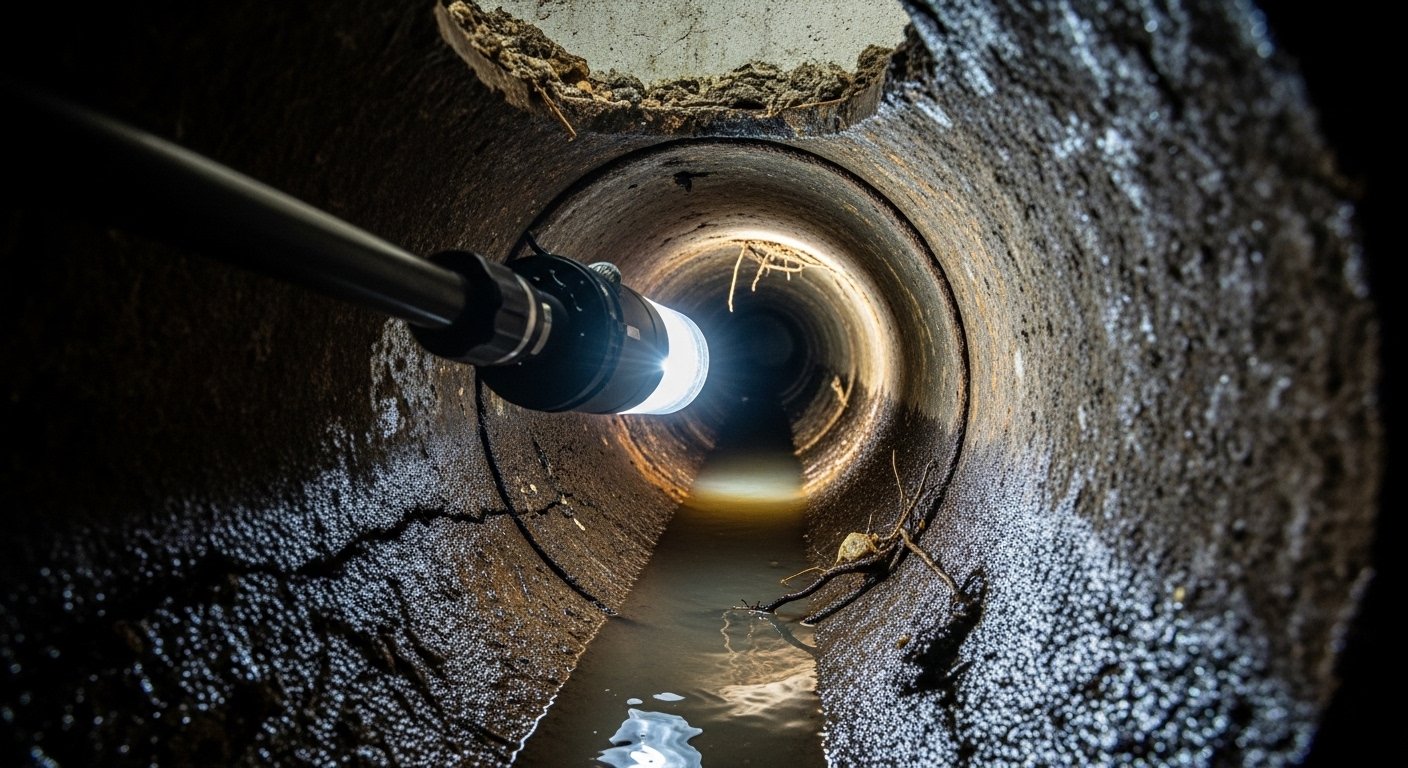
A sewer camera inspection in Bradenton sends a waterproof camera through the actual pipe and shows you exactly what’s there: any cracks, roots, bellies, buildup, joint separations. You watch it in real time and get the footage. That’s just information your home inspection doesn’t include.
Pro tip: When you’re scheduling your general inspection, add a sewer scope at the same time. Most plumbing companies can coordinate the timing, and doing both on the same day is usually easier to negotiate around.
2. Bradenton’s Tree Population Is a Real Threat to Underground Pipes
Spend five minutes driving through older Bradenton neighborhoods and you’ll notice the tree canopy. Mature live oaks, big laurel figs, sprawling magnolias — it’s genuinely beautiful. And those trees are doing something underground that you cannot see from the street.
Florida tree roots are aggressive year-round because there’s no winter dormancy to slow them down. They grow continuously, they grow laterally, and they find underground pipe joints the way water finds a crack — patiently, inevitably, until they’re through.
A live oak with a 40-foot canopy might have a root system that extends 60–80 feet horizontally. If there’s a sewer line in that radius, the roots have likely found it, or they will. Once roots establish inside a pipe, they start restricting flow immediately and they don’t stop growing until someone cuts them out.
Here’s the scenario I’ve heard more than once: buyers fall in love with a shady older home, skip the sewer scope, close on the house, and six months later they’re getting a call from a plumber who’s found roots so dense they’ve reduced the pipe to maybe 20% of its original diameter. That’s a $6,000–$12,000 repair conversation that could have been a negotiation point or a walk-away.
Bottom line: If there are mature trees within 50 feet of the home’s sewer line path, a camera inspection isn’t optional. It’s the thing you do.
3. Older Bradenton Homes Have Pipes That Were Never Meant to Last This Long
Florida saw significant residential development in the 1950s, 60s, and 70s. A lot of that housing stock is still being bought and sold today — and a lot of those original sewer pipes are still in the ground.
Cast iron and clay were the standard pipe materials for that era. Cast iron corrodes from the inside out over decades — the interior roughens, collects buildup more easily, and eventually cracks. Clay pipes are brittle, prone to fracturing from ground pressure, and the joints can separate as soil shifts. Neither material was designed to last 60 years, but here we are.
Here’s what this looks like in practice. You’re buying a 1968 bungalow in east Bradenton. The sellers have lived there 12 years with no major plumbing problems. But the original clay sewer lateral has three spots where the pipe has bellied downward from soil settling — those low spots collect waste instead of flushing it through — and there’s a hairline fracture near the street connection. Nothing has failed catastrophically. Yet.
A camera inspection shows you all of this before you own it. Without one, you’re inheriting a known but invisible problem and calling it a surprise.
4. Septic Systems Add a Whole Additional Layer of Risk
If the home you’re buying is on a septic system rather than municipal sewer — and in Manatee County, a meaningful number of residential properties are — the stakes of skipping an inspection go up significantly.
A standard home inspection will note that a septic system exists. Some inspectors will do a basic assessment: they’ll locate the tank, check if it’s been pumped recently, maybe do a flush test. But they won’t evaluate the condition of the drain field. They won’t tell you if the distribution box is failing or if the leach lines are saturated.
A proper septic inspection in Bradenton that includes camera work on the outlet line can reveal a lot — tank condition, outlet baffle integrity, whether the inlet pipe is damaged, and whether there’s evidence of root intrusion into the tank or lines.
Septic replacement in Florida runs $8,000 to $20,000 or more depending on the property and the type of system required. That’s not the kind of thing you want to discover after the keys are in your hand.
If the listing says “septic” and the seller’s disclosure doesn’t include recent service records or pumping receipts, be skeptical. Ask for them. And get your own inspection.
5. Camera Footage Is a Genuine Negotiating Tool
Here’s an angle people don’t always think about: even if a sewer camera inspection finds something, that’s not necessarily a reason to walk away. It might be leverage.
If the camera shows significant root intrusion, a pipe belly, or early corrosion on cast iron, you now have documented evidence of a real issue — on video — that you can bring to the negotiating table. A seller who didn’t know (or says they didn’t know) now has to respond. Options include:
- Seller credits you the estimated repair cost
- Seller arranges and pays for repairs before closing
- You adjust your offer price to reflect the deferred maintenance
- You decide the risk is too high and walk away with your earnest money intact (depending on how your inspection contingency is written)
Without the footage, you’d either walk in blind or try to negotiate on a vague “plumbing concern” with nothing to back it up. The camera footage gives you something specific and undeniable.
I’ve seen buyers get $5,000–$10,000 in seller concessions based on sewer camera findings. The inspection itself costs $150–$300. That’s a meaningful return on a pretty small investment.
6. Florida’s Soil Movement Creates Pipe Problems That Look Fine From Outside
This one’s subtle, and most buyers don’t hear about it until after the fact.
Florida soil — especially in coastal, low-lying areas and on lots with sandy fill — shifts. It compacts differently in wet vs. dry seasons. Properties built on fill soil settle unevenly over decades. When the ground moves, underground pipes move with it.
A pipe that was installed at a proper grade — meaning a slight downhill angle that lets gravity move waste through — can develop low spots, called bellies, where soil settling has caused a section to sag. Waste collects in that belly. It doesn’t flush through cleanly. Solids accumulate. Clogs start forming regularly even when nothing seems obviously wrong with the plumbing inside the house.
You can live in a house for years with a pipe belly and just think you “have old pipes” or “need to watch what you flush.” You might never know. But a camera shows it immediately — you can see the standing water in the low section right there on the screen.
Pipe bellies can sometimes be addressed with hydro-jetting maintenance; more significant cases require excavation and pipe repair or relining. Either way, it’s information you want before you’re the homeowner.
7. The Cost Is Small Relative to Everything Else You’re Spending
You’re about to make one of the largest financial commitments of your life. You’re paying for a home inspection, a termite inspection, an appraisal, title insurance, survey costs, closing costs… the list is genuinely long.
A sewer camera inspection in the Bradenton area typically runs $150–$300. Some plumbing companies include it in a bundled pre-purchase inspection package. Relative to everything else you’re spending — and relative to what it can find — this is not a place to cut corners.
Think about it this way: if the inspection finds nothing, you get peace of mind and some useful documentation about the condition of the underground infrastructure you’re inheriting. If it finds something, you have information that can protect you financially before the deal closes. Either outcome is worth $200.
The homebuyers who tell me they wish they’d done it are the ones who skipped it. I haven’t heard from anyone who did it and felt like they wasted their money.
Quick Reference: When a Sewer Camera Inspection Is Especially Important
| Home Situation | Camera Inspection Priority |
|---|---|
| Built before 1985 | High — original pipes may still be in place |
| Mature trees on the property | High — root intrusion is likely |
| On septic system | High — septic and lateral lines both need evaluation |
| Coastal or low-lying lot | High — soil shifting and pipe bellies common |
| Multiple previous owners | Medium-High — maintenance history often incomplete |
| Recently renovated | Medium — renovations don’t always include pipe work |
| New construction (post-2005, PVC) | Lower — but still worth confirming before closing |
Key Takeaways
- A standard home inspection doesn’t include the underground sewer lateral — a sewer camera inspection is the only way to see what’s there.
- Florida’s aggressive tree roots, year-round growth season, and aging pipe infrastructure make camera inspections more important here than in most states.
- Bradenton’s older housing stock likely includes cast iron or clay pipes that are past their expected lifespan — condition varies significantly by property.
- Septic system homes carry additional risk; a pre-purchase septic and camera inspection is strongly advisable.
- Sewer camera findings can be used as genuine negotiating leverage — you’re not just protecting yourself, you’re gathering information.
- At $150–$300, the cost is minimal relative to what it can reveal and relative to the overall transaction.
So, Should You Get One? (You Already Know the Answer)
Here’s my honest take: if you’re buying a home in Bradenton that was built before 2000, has any mature trees on the lot, or is on a septic system — yes. Full stop. This isn’t me trying to sell you on something. It’s the same thing I’d tell a friend who called me the day before they were supposed to close.
The worst outcome of getting a sewer camera inspection is that everything looks fine and you move in with confidence. The worst outcome of skipping it is discovering a $10,000 problem three months after you’ve unpacked.
That’s not really a hard call.
If you’re in the middle of a purchase right now and want to schedule an inspection before closing, get it on the calendar as soon as your offer is accepted. You want that within your inspection contingency window, not after. A good sewer inspection company in Bradenton can usually get out within a day or two and turn around the report quickly.
Go in with your eyes open. You’ll be glad you did.
FAQ
Does a sewer camera inspection take long? Usually 45–90 minutes for a standard residential property. The camera work itself is often done in 30 minutes; the rest is setup, access, and going over the findings with you.
Who pays for the sewer camera inspection — buyer or seller? In most transactions, the buyer pays as part of their due diligence. It’s your inspection, your information. If findings support a price negotiation or repair request, that’s a separate conversation.
What if I can’t get a camera inspection before my closing date? Push for it. Ask your agent to extend the inspection contingency if needed — this is completely normal and sellers generally accommodate it. Closing without this information on an older Florida home is a meaningful risk.
Can the camera damage the pipes? No. The inspection camera is flexible, waterproof, and sized for residential sewer lines. It goes through passively and doesn’t apply any pressure to the pipe walls.
What happens if the camera finds a problem? You get documentation — usually video footage and a written report. From there, it’s your choice: negotiate with the seller, request repairs before closing, adjust your offer, or walk away. Having the information is always better than not having it.
Do new homes need sewer camera inspections too? It’s less urgent for new construction with PVC pipes, but installation errors, improper grading, and construction debris in the lines do happen. Some buyers do it on new builds just to confirm everything was done right. Not a bad idea if you can fit it into the timeline.


Comments are closed