


Article Metadata
Title: Slug: Tags: Meta Description: Older Bradenton homes hide serious sewer problems you can’t see. Here’s what a camera inspection actually finds — and why the results often surprise homeowners.
What a Sewer Camera Inspection Reveals in Older Bradenton FL Homes
A family buys a 1972 home in a quiet Bradenton neighborhood. The house is solid — updated kitchen, newer roof, good bones. The inspection comes back mostly clean. They close, they move in, they start making it their own.
Three months later, the toilets are gurgling. A few weeks after that, the shower drains stop draining. Then comes the call from a plumber who’s just fed a camera through the main line: original clay pipes, two sections completely collapsed from soil shifting, and roots so thick in one stretch that the pipe is essentially a planter at this point.
Repair estimate: $11,400.
They didn’t know. They couldn’t have known — not without a camera. And that’s exactly the thing about older homes in Bradenton. They carry history underground that nobody tells you about, and that history has a way of showing up at the worst possible moment.
What’s Actually Down There — and Why Bradenton Is Different
Here’s some context that matters: Bradenton and the surrounding Manatee County area have a significant housing stock from the 1950s through the 1980s. A lot of those homes have never been repiped. The original sewer laterals — the underground pipes that carry waste from the house to the street or septic system — are still in the ground, doing their best, often decades past their intended service life.
The materials used in that era were cast iron and clay. Both have real failure modes that show up predictably in Florida’s conditions. And Florida’s conditions are not gentle on underground pipes — high water table, aggressive tree roots that grow year-round without a dormant season, sandy and shifting soils in coastal areas, and hard water with significant mineral content.
A sewer camera inspection in Bradenton is essentially a direct look at the result of all those forces acting on aging infrastructure, sometimes for fifty or sixty years. What the camera finds tends to fall into a few predictable categories. And each one tells a story.
What the Camera Actually Shows
Corrosion and Interior Pipe Degradation
Cast iron corrodes from the inside out. New cast iron pipe has a relatively smooth interior surface. After 30, 40, 50 years in the ground in Florida, that surface becomes rough, pitted, sometimes deeply eroded.
The camera shows this clearly — you can see the texture change from what the pipe should look like to what it actually looks like. That roughness matters because it’s where everything catches. Grease, soap, small debris, toilet paper that would otherwise flush cleanly — it all snags on corroded pipe walls and starts accumulating.
This is often the real explanation behind a drain that’s “always been a little slow.” Not a clog exactly. Just a pipe that’s been narrowing for years.
Root Intrusion — Often More Extensive Than Expected
This is the finding that surprises people most, even when they knew roots were possible.
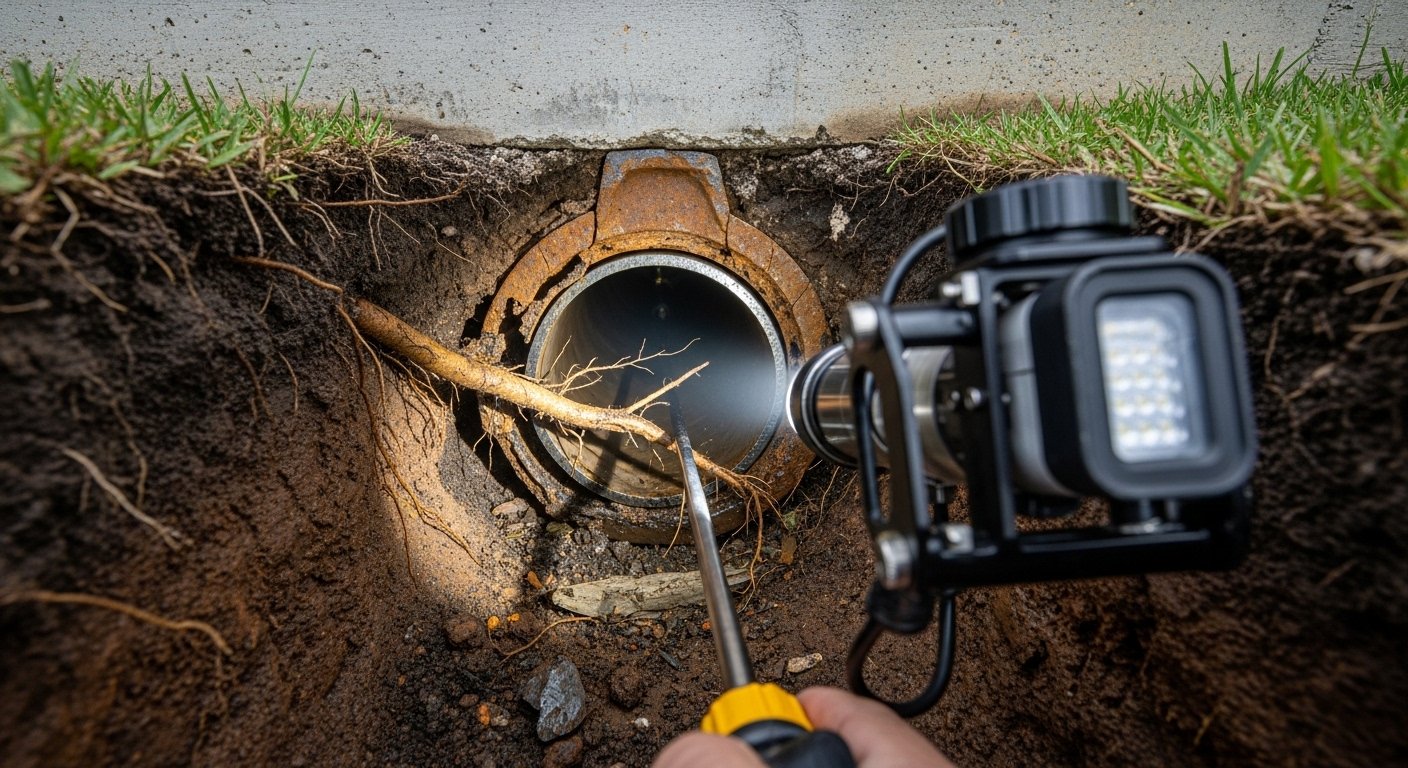
The camera doesn’t just show that roots are present. It shows how far they’ve grown into the pipe, how dense they are, and whether they’ve caused any structural damage to the pipe wall. Sometimes it’s a few tendrils near a joint — manageable, clearable with hydro-jetting. Sometimes it’s a mass that’s completely filling a six-inch pipe for several feet.
Bradenton’s mature tree canopy is gorgeous. It’s also relentless underground. Live oaks, laurel figs, and certain palms send roots laterally for extraordinary distances seeking moisture, and old clay pipe joints with any deterioration are an open invitation. A tree that’s been on the property for 30 years has had 30 years to work on those joints.
Pro tip: When watching the camera footage, pay attention to where the roots are entering the pipe, not just that they’re there. Entry near a joint that can be relined is a very different situation than entry through a crack in the middle of a pipe section.
Pipe Bellies and Grade Problems
This one is invisible from any other angle — you can only see it on camera because it requires watching how water behaves inside the pipe.
A pipe belly is a low spot where soil settling has caused a section of pipe to sag below the proper downhill grade. Water and waste should flow continuously toward the connection point, pushed by gravity. In a belly, they pool. Solids accumulate in that pooled section. It’s a slow-build problem that looks like recurring drain issues from inside the house.
Florida soil shifts. Coastal and low-lying Bradenton lots, properties built on fill, areas near the water — all of them have experienced some degree of soil movement over decades. The camera shows the standing water in the sag, and a plumber who knows what they’re looking at can estimate the severity.
Mild bellies can sometimes be managed with regular maintenance. Significant ones need excavation and pipe repair or replacement.
Joint Separations and Cracks
Old clay pipes are held together at joints — sections of pipe that fit together and are sealed with some kind of mortar or grout. Over time, soil movement, root pressure, and the simple physics of decades of use can cause those joints to separate. Cracks can also develop in the pipe body itself from ground pressure.
The camera shows this clearly: a gap at a joint, a fracture in the pipe wall, sometimes a section where the pipe has partially collapsed. These aren’t just structural concerns — they’re also points where groundwater can infiltrate the sewer line (which increases the load on the system) and where effluent can leak into the surrounding soil.
A collapsed section is non-negotiable. You can’t route around it with cleaning. The pipe needs repair or replacement.
Mineral Scale Buildup
In areas of Bradenton with hard water — which includes a lot of the county — minerals deposit on the interior walls of pipes over years. It’s the same process that leaves white crust around your faucets and showerheads, just happening inside underground pipes where you can’t see it.
The camera shows this as a gradual narrowing — the pipe diameter visibly reduces as you move the camera forward. A pipe that started life at 4 inches might be effectively 2.5 or 3 inches after 40 years of mineral accumulation. That’s a significant reduction in flow capacity, and it makes every other clog problem worse.
Mineral scale in drain pipes can often be addressed with professional hydro-jetting. But on cast iron that’s already corroded, high-pressure water needs to be used carefully — it can be too much for a pipe that’s already compromised.
What Experts Notice That Homeowners Miss
When a plumber runs a sewer camera inspection on an older Bradenton home, they’re not just cataloging problems. They’re reading a timeline.
The condition of the pipe tells you a lot about what’s been done — and not done — over the years. A pipe with heavy root intrusion but no evidence of prior root cutting has been ignored. Scale buildup that’s severe and uniform suggests years without any maintenance. A section of newer PVC spliced into old clay tells you a repair was done at some point, which raises the question of what prompted it.
Experienced inspectors also look at what’s not there. If the camera shows debris buildup near a cleanout, that’s different from buildup mid-line. If the roots are entering from one specific side, the direction can sometimes tell you which tree is the source.
The footage itself matters too. A written report that says “root intrusion noted” doesn’t give you what the video gives you. Ask to watch the camera inspection live, or at minimum ask for the video recording. You want to see what you’re dealing with, not just read a summary of it.
What to Do With What the Camera Finds
Getting a camera inspection and then not knowing what to do with the findings is frustrating. Here’s a simple way to think through next steps:
If the camera shows minor buildup or early root intrusion: Hydro-jetting to clean the line, followed by a maintenance schedule (annual or bi-annual inspection and cleaning) is usually the right approach. You’re managing an aging system, not replacing it.
If there are pipe bellies or partial joint separations: Get a second opinion on the severity before committing to excavation. Some situations warrant pipe relining — a trenchless method that places a new liner inside the existing pipe — which is less invasive and less expensive than full dig-and-replace.
If the camera shows a collapsed section, extensive cracking, or severely compromised pipe: This needs repair, full stop. The question is whether spot repairs are sufficient or whether replacement of the full lateral makes more sense. A plumber who’s done this in Bradenton’s soil conditions will have a grounded perspective on that.
If you’re a buyer and the camera revealed this before closing: Document everything. Get a repair estimate from a qualified sewer inspection and repair professional in Bradenton. Use it as negotiating ground — seller credit, price adjustment, or repair before closing.
FAQ
How long does the camera inspection take on an older home? Usually 45–90 minutes. Older pipes sometimes require a bit more maneuvering if there’s significant buildup or joint irregularities, so give it a full hour. The plumber should walk you through what they’re seeing as they go.
Can the camera damage old clay or cast iron pipes? The inspection camera itself won’t — it’s flexible and passive. The concern is if hydro-jetting follows the inspection on a severely compromised pipe. That’s why reputable plumbers do the camera assessment first before deciding how to proceed.
What if the camera can’t get all the way through the line? It happens, usually because of a collapsed section or severe blockage. The camera typically makes it far enough to identify the problem zone and its approximate location. That’s actually useful information — it tells you where to excavate if repair is needed.
Is it worth doing on a house that’s had recent plumbing work? Yes, depending on what the work involved. If someone repiped the interior but left the original lateral in place, the camera inspection is still essential — the exterior line often hasn’t been touched.
How often should older Bradenton homeowners do this inspection? If you’re in a home with original pre-1980 pipes, every 2–3 years is reasonable as ongoing maintenance. After a major storm season or any significant ground disturbance near the sewer line path, that’s also a good trigger.
The Thing About Old Homes
There’s something genuinely wonderful about Bradenton’s older neighborhoods — the mature trees, the established lots, the homes with real character that newer construction just can’t replicate. None of that changes.
But those homes carry underground history that deserves a clear look. Not to scare you. Not because something is definitely wrong. Just because what you don’t know eventually shows up on a plumber’s invoice, and it’s always better to find out on your terms.
A sewer camera inspection is a couple hundred dollars and an afternoon. What it gives you is a clear picture of what’s actually going on beneath a property you care about. That’s worth having — whether you’re buying, selling, or just finally ready to stop wondering why the drains never quite feel right.
You deserve to know what’s down there. It’s your house.


Comments are closed