


Trenchless vs. Traditional Sewer Repair: A Bradenton Guide
Picture this: a plumber knocks on your door and says you have a failing sewer line. And then — almost casually — he says you have two options. One involves digging a trench through your yard. The other doesn’t.
Your yard. The one with the mature oak tree you’ve been watching grow for fifteen years. The one with the pavers you had installed last spring.
That’s the moment most homeowners in Bradenton first get introduced to the trenchless vs. traditional pipe repair conversation. And it’s a terrible time to be learning about it for the first time — stressed, blindsided, with a plumber waiting on an answer.
So let’s have this conversation now, when there’s no pressure. Because the honest truth is that both methods have real merit depending on your situation, and the “right” answer isn’t always the obvious one. If you want to get a sense of what trenchless looks like in practice, our trenchless pipe repair services in Bradenton, Florida are worth a look — but first, let’s make sure you actually understand what you’re choosing between.
What We’re Actually Comparing Here
Before we get into pros and cons, let’s make sure we’re on the same page about what each method actually involves. Because “trenchless” is one of those words that sounds self-explanatory but covers a couple of different techniques that work quite differently.
Traditional (Open-Cut) Pipe Repair
This is the original method. A crew digs a trench — sometimes several feet deep, as long as the damaged section of pipe — removes the old pipe, installs new pipe, and backfills the trench. If the pipe runs under a driveway, patio, landscaping, or any structure, all of that gets excavated and then (ideally) restored.
It’s straightforward. The technology has been around forever. And it works completely reliably when done right.
The disruption is real, though. We’re talking about a meaningful section of your yard — or more — being dug up, potentially for several days. In Bradenton’s older neighborhoods especially, where trees have grown up around underground pipes for decades, that excavation can be complicated and expensive.
Trenchless Method #1: Pipe Lining (CIPP — Cured-in-Place Pipe)
This is what it sounds like: instead of replacing the old pipe, you line the inside of it with a new one. A flexible liner saturated with resin is inserted into the existing pipe, inflated so it presses against the pipe walls, and then cured (hardened) in place — either with hot water, steam, or UV light depending on the system used.
What you end up with is essentially a new pipe inside the old one. It’s slightly smaller in diameter (usually by about a quarter inch), but it’s smooth, sealed, and resistant to roots and corrosion. The old host pipe becomes a structural shell around it.
No digging. One or two access points.
Trenchless Method #2: Pipe Bursting
This one is different. Instead of lining the existing pipe, a bursting head is pulled through it, fracturing the old pipe outward while simultaneously pulling a new pipe in behind it.
This is used when the existing pipe is too damaged or structurally compromised to serve as a liner host — or when you want to upsize to a larger diameter pipe at the same time. It requires access points at both ends of the section being replaced, and the ground needs to be stable enough to handle the lateral force without disturbing nearby utilities or structures.
The Real-World Comparison: Cost, Disruption, and Results
Cost
Let’s put real numbers on this, because vague ranges don’t help anyone.
Traditional pipe repair in Bradenton typically runs $50–$150 per linear foot for the pipe work itself. But that’s before you factor in restoration — replacing the sod, resetting pavers, repaving a section of driveway, replanting landscaping. Restoration costs are notoriously hard to estimate until you see what’s under the ground, and they can easily add $1,000–$5,000+ to the total depending on what’s above the pipe.
For a typical sewer line repair of 20–40 linear feet, you’re looking at a base range of $2,000–$6,000 in excavation and pipe work, potentially more with restoration.
Pipe lining (CIPP) runs higher per linear foot — typically $80–$250 per linear foot — because the materials and equipment are more specialized. But that’s usually the whole cost. No restoration. No landscaping replacement. No driveway patching.
On a 30-foot run, traditional might come in at $2,500 in pipe work plus $2,000 in restoration — $4,500 total. Pipe lining might quote $5,000 for the same section. The gap narrows or disappears once you factor in what traditional excavation disturbs.
Pipe bursting tends to fall in a similar range as lining, sometimes slightly higher because of equipment requirements.
Here’s the thing nobody tells you upfront: the cost comparison depends enormously on what’s above the pipe. A simple repair under an open lawn might genuinely be cheaper with traditional methods. The same repair under a tiled patio or a driveway can flip entirely in trenchless’s favor.
Disruption
This is where trenchless really earns its reputation.
Traditional excavation means equipment in your yard, a trench that may be there for multiple days, potentially disrupted water service, and a yard that looks like a construction site for a while. If the pipe runs near roots of mature trees — extremely common in Bradenton’s established neighborhoods — excavation also means root removal that can stress or kill trees you’ve been growing for decades.
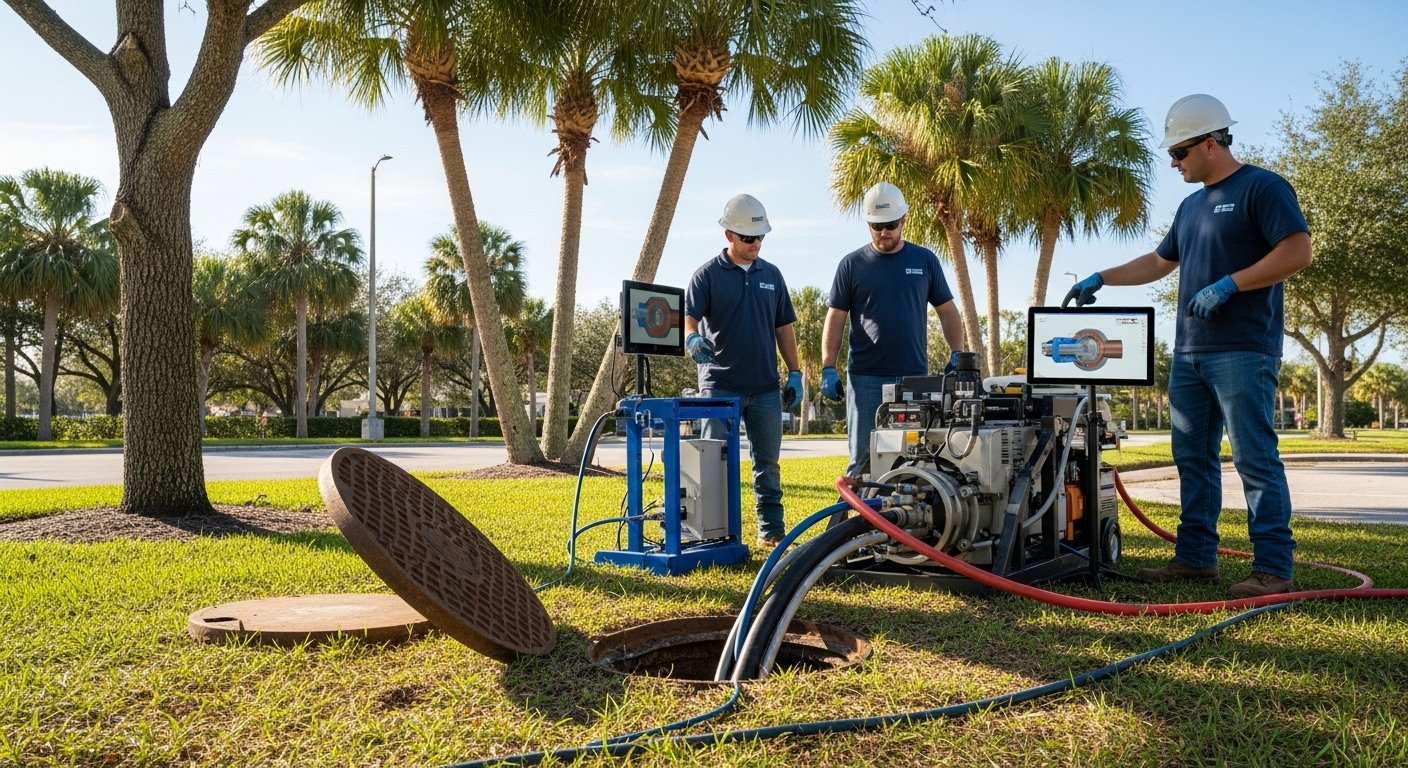
Trenchless repair typically means one plumber, a camera inspection first, access pits at one or two points, and a job that’s often done in a single day. Your yard mostly looks the same when they leave.
For homeowners with landscaping they care about, or pavers, or any hardscape over the pipe run, this isn’t a small distinction. It can be the entire conversation.
Durability and Longevity
This is where trenchless sometimes gets undersold. People assume “new pipe” from traditional repair must be more durable than a liner. Not necessarily.
Cured-in-place pipe lining, done correctly, is rated for 50+ years. The epoxy resin is seamless, which eliminates joint failures. It’s highly root-resistant because there’s nothing for roots to get into. And the smooth interior actually improves flow compared to an old, corroded, or root-infiltrated original pipe.
Traditional replacement with new PVC or HDPE pipe is also durable — easily 50+ years if installed properly. The weak points are the joints and the quality of the installation, just like any pipe.
Both methods, done well, are genuinely long-term solutions. The durability argument doesn’t meaningfully favor one over the other.
What Each Method Can’t Do
Trenchless lining can’t help if the pipe has already collapsed — there needs to be enough structural integrity for the liner to have something to press against. Severely offset joints (where the pipe has shifted and sections no longer align) can also be tricky for lining. And if you have a bellied pipe — a section that’s sunk and holds standing water — lining doesn’t fix the underlying grade issue.
Pipe bursting handles collapse better than lining since it’s destroying and replacing the old pipe. But it requires stable soil and enough clearance from other utilities, and it’s not ideal in every soil condition or pipe configuration.
Traditional excavation has none of these limitations — you can fix anything with a shovel and new pipe. But the tradeoffs in cost and disruption are real.
Side-by-Side Comparison
| Factor | Traditional (Open-Cut) | Pipe Lining (CIPP) | Pipe Bursting |
|---|---|---|---|
| Avg. cost per linear foot | $50–$150 + restoration | $80–$250 (all-in) | $100–$250 (all-in) |
| Yard disruption | High | Minimal | Low–Minimal |
| Job duration | 1–5 days | 1–2 days | 1–2 days |
| Works on collapsed pipe | Yes | No | Yes |
| Pipe diameter options | Flexible | Same or slightly smaller | Can upsize |
| Longevity | 50+ years | 50+ years | 50+ years |
| Best for | Open yards, major damage, budget-sensitive when no hardscape | Deteriorating but intact pipe, hardscaped areas | Collapsed or severely damaged pipe, root intrusion |
| Restoration costs | Significant | Minimal | Minimal |
Expert Take: Which Method for Which Situation
After seeing a lot of these repairs across Bradenton, here’s how we’d break it down honestly.
Go trenchless (lining) when: your pipe is deteriorating, root-infiltrated, or cracked but still basically in its original shape and alignment — AND you have landscaping, pavers, a driveway, or mature trees above or near the pipe run. This is the most common scenario we see where lining makes clear sense. The cost premium almost always pays for itself in avoided restoration.
Go pipe bursting when: the pipe has sections that are too damaged or misaligned for lining to work, but you still want to minimize excavation. Also a good call when you want to upsize the pipe diameter at the same time.
Go traditional when: the pipe damage is accessible and there’s genuinely nothing above it worth protecting, OR when there’s a structural issue (severe bellying, significant grade problems) that trenchless can’t address. Also worth considering if you have a very long run where the per-foot cost difference makes traditional significantly cheaper and the surface above is just grass.
Here’s something I’d caution against: choosing traditional just because the quote is lower. Make sure you’re comparing apples to apples — that the traditional quote includes realistic restoration costs. If it doesn’t, you could be in for a surprise.
And be wary of any contractor who insists there’s only one right answer without doing a camera inspection first. A proper camera inspection of the line is what tells you the actual condition, configuration, and what options are realistically on the table. Any recommendation made without one is a guess.
Decision Framework: How to Choose for Your Specific Situation
Work through these questions in order:
1. What’s the actual condition of the pipe? If it’s already collapsed, lining is off the table. You need a camera inspection to know this — not an assumption.
2. What’s above the pipe? Open lawn with nothing special? Traditional may be fine. Pavers, mature landscaping, a driveway, a patio? Trenchless almost certainly wins on total cost once restoration is included.
3. What’s your timeline? Traditional excavation can stretch to several days, especially if restoration is involved. If you need the problem resolved quickly and minimally disruptively, trenchless has an edge.
4. Are you comparing complete quotes? Ask both options to be quoted with all costs included — materials, labor, access restoration, surface restoration. A trenchless quote that looks higher on paper often comes in lower once a traditional quote’s restoration is honestly accounted for.
5. Get at least two opinions. Not because you can’t trust any one contractor, but because pipe repairs are significant expenses and different plumbers genuinely have different equipment, training, and comfort levels with each method. A plumber who rarely does trenchless work may steer you toward traditional by default. Seek out someone who does both and will be honest about the tradeoffs.
Our trenchless pipe repair team in Bradenton offers camera inspections so you know exactly what you’re dealing with before any recommendation is made. That’s the right starting point regardless of who you end up working with.
Frequently Asked Questions
Is trenchless pipe repair as reliable as traditional replacement? Yes, when done correctly. Properly installed CIPP lining and pipe bursting are both rated for 50+ years by manufacturers and have strong real-world track records. The key is proper installation — camera inspection, surface preparation, correct curing. A botched trenchless job is worse than a botched traditional one because it’s harder to fix.
Will trenchless repair work on my cast iron pipes? Usually yes. In fact, deteriorating cast iron is one of the most common use cases for pipe lining in older Florida homes. The cast iron host pipe provides a good shell for the liner, and the lining stops further corrosion and root infiltration.
What about clay pipes? Clay pipes are very common in Bradenton’s older neighborhoods and are well-suited to trenchless lining as long as they haven’t collapsed. Clay deteriorates over time and tends to attract root infiltration at the joints — exactly the situation where lining performs well.
Does homeowners insurance cover pipe repair? Sometimes, and it depends heavily on cause. Sudden failures may be covered; gradual deterioration usually isn’t. Tree root damage is often explicitly excluded. Check your policy before assuming either way, and ask your plumber to document the cause clearly during inspection.
How long does trenchless pipe repair take? Most CIPP lining jobs are completed in one day for typical residential runs. Pipe bursting is similar. Both require cure time before the line is back in full service — usually a few hours for hot water or steam curing. Your plumber will tell you the specific timeline for your job.
So — Which Should You Choose?
Honestly, I can’t tell you from here without knowing what’s in your yard and what the camera shows inside your pipe. And anyone who gives you a definitive answer without that information is guessing.
What I can tell you is this: don’t let the decision be made for you by whoever gives you the first quote. Understand both options. Ask for a camera inspection. Make sure any comparison accounts for the full cost of each approach — including what gets dug up, damaged, and replaced.
Bradenton’s established neighborhoods have old pipes, mature trees, and beautiful landscaping that homeowners have spent years building. Trenchless repair often means you get to keep all of it. That’s worth knowing about before a shovel goes in the ground.
If you’d like a camera inspection to see what you’re actually working with, reach out to our team about trenchless pipe repair in Bradenton. No obligation — just real information so you can make a smart decision either way.
That’s all we’d want if it were our yard on the line.


Comments are closed