


You know that specific “wake-up call” that happens when you’re the third person to shower in the morning? You’re just getting the shampoo in your hair, and suddenly, the water turns into a liquid glacier. It’s frustrating, it’s a shock to the system, and it usually happens right when you’re already running ten minutes late.
Choosing between Tankless vs Traditional Water Heaters isn’t just about plumbing specs; it’s about your morning sanity. Whether you’re tired of running out of hot water or you’re looking at your electric bill and wondering why it’s so high, I want to help you make sense of these two options. Honestly, there isn’t a “perfect” choice for everyone—there’s just the choice that fits your family’s lifestyle.
If your current unit is already leaking or making scary knocking sounds, you might want to check out our water heater services in Sarasota to see what an upgrade looks like. But if you’re just in the “thinking about it” phase, let’s dive into how you can decide which one is right for you.
Prerequisites: What You Should Know Before You Choose
Before we get into the step-by-step comparison, you need to take a quick look at your home’s current setup. Think of this as the “homework” that saves you money later.
- Your Fuel Source: Do you have natural gas, propane, or is your home strictly electric? This changes the cost of a tankless unit significantly.
- Family Size: Are you a solo flyer or do you have four kids who all play sports and need back-to-back showers?
- Space Constraints: Do you have a big dedicated “utility closet,” or are you trying to reclaim some garage space?
- Budget (Now vs. Later): Are you looking to save money on the install today, or are you looking for the lowest monthly bill for the next 20 years?
Step-by-Step: Evaluating the Right Choice for Your Home
Step 1: Understand How They Actually Work (The “Coffee Shop” Explanation)
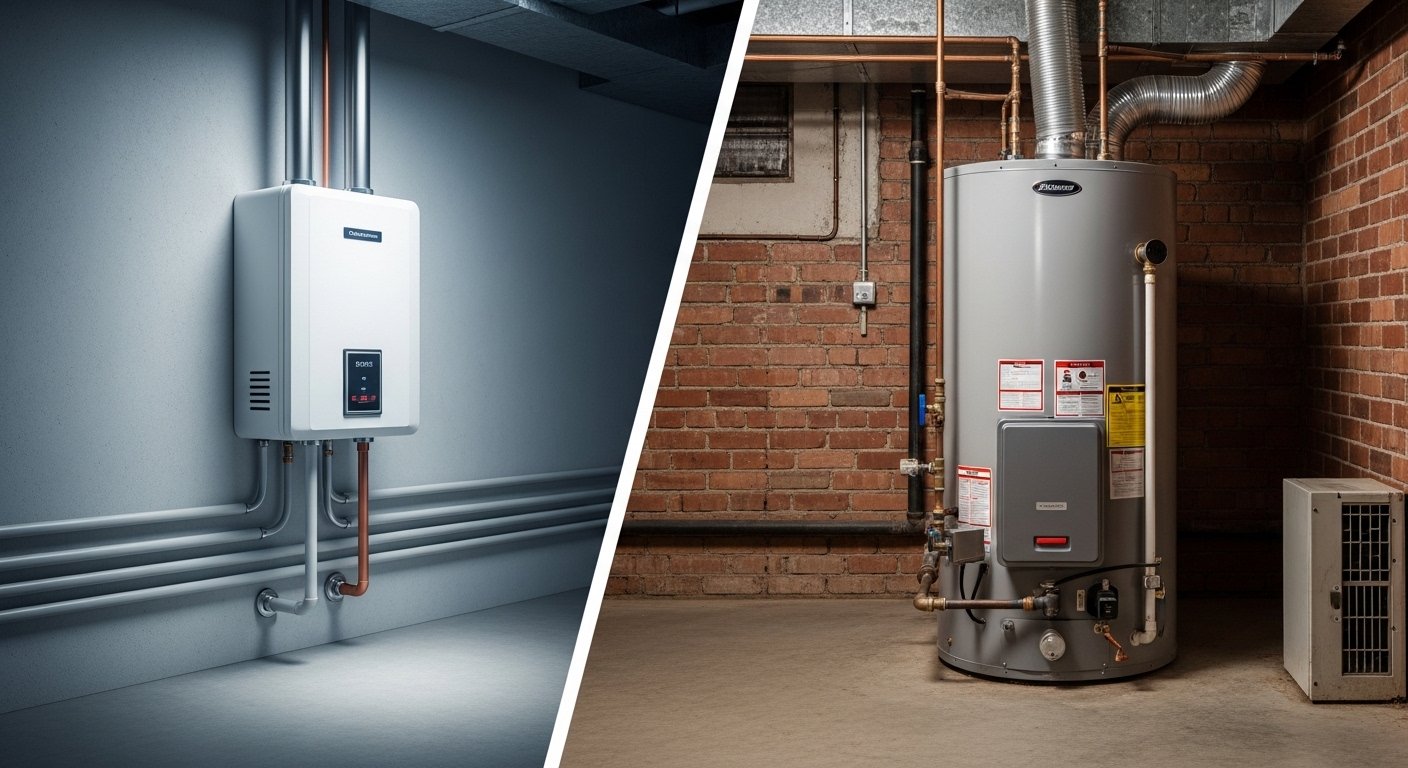
Think of a traditional tank water heater like a giant thermos. It keeps 40 or 50 gallons of water hot 24/7, just waiting for you to use it. It’s reliable, but it’s constantly using energy to keep that water warm even while you’re asleep.
A tankless water heater is more like a high-powered electric kettle. It doesn’t store water at all. When you turn on the tap, it flash-heats the water as it flows through the unit.
Step 2: Look at the Upfront Installation Costs
Let’s be real: traditional heaters win on the initial price tag. You can usually swap an old tank for a new one fairly easily.
Tankless units are a bigger investment. Why? Because they often require an upgrade to your gas lines or your electrical panel to handle the high-power demand of heating water instantly. But—and here’s the catch—they can last twice as long as a tank. You’re basically pre-paying for your next two water heaters.
Step 3: Assess the “Infinite Hot Water” Factor
If you have a big Roman tub or a family that showers at the same time, tankless is a dream come true. You won’t run out. Ever.
But keep in mind, tankless units have a “flow rate.” If you try to run the dishwasher, the washing machine, and two showers at once, the water might not be as hot as you want. Traditional tanks give you a huge burst of hot water all at once, but once it’s gone, you’re waiting 45 minutes for a “recharge.”
Step 4: Compare Space and Aesthetics
Traditional tanks are big, bulky cylinders. They take up a lot of floor space. Tankless units are about the size of a carry-on suitcase and mount on the wall. If you’re trying to turn your utility room into a pantry, tankless is the way to go.
Step 5: Factor in Maintenance and Lifespan
Traditional tanks usually give you about 10–12 years. They are prone to rust because, well, they are metal tanks full of water. Tankless units can easily go 20 years or more if they are maintained.
Pro Tip: In Sarasota, our water can be a bit “hard.” Whether you choose tank or tankless,maintaining your plumbingby flushing the system once a year is the best way to protect your investment.
Troubleshooting: Common Concerns
“I heard tankless heaters take forever to get hot water to the sink.”
This is a common misconception. The “wait time” for hot water is usually about the distance from the heater to the faucet, not the heater itself. If your heater is in the garage and your bathroom is on the other side of the house, it’ll take a minute regardless of the type. You can fix this with a small recirculation pump.
“What if the power goes out?”
Traditional gas tanks will still give you the 50 gallons they already have heated. Most tankless units (even gas ones) use an electronic ignition, so if the power is out, you might be out of hot water too unless you have a battery backup.
“Is it true tankless heaters need a lot of repairs?”
Not necessarily repairs, but they do need maintenance. Because they heat water so quickly, scale (calcium buildup) can happen faster. If you don’t flush a tankless unit, it’ll eventually shut down to protect itself.
Expert Insights: What I’ve Seen in the Field
Look, I’ve walked into a lot of homes where people regretted their choice because they didn’t think about the lifestyle fit.
I remember one family in Osprey who insisted on a tankless unit because they loved the tech. But they were a retired couple who only used one shower and did laundry once a week. For them, the $3,000+ installation didn’t make financial sense—they would never recoup that in energy savings.
On the flip side, I’ve seen families in Sarasota with four teenagers who were literally fighting over shower times. Installing a tankless unit water heater didn’t just save them money; it saved their relationships.
My stance? If you plan on staying in your home for 10+ years and you have a high demand for water, go tankless. If you’re on a budget or planning to move in a year or two, stick with a high-efficiency traditional tank.
Summary & Next Steps
Choosing between Tankless vs Traditional Water Heaters comes down to balancing your current budget against your future comfort.
Quick Comparison Table
| Feature | Traditional Tank | Tankless |
| Upfront Cost | Lower ($) | Higher ($$$) |
| Lifespan | 10-12 Years | 20+ Years |
| Hot Water Supply | Limited to Tank Size | Continuous/Endless |
| Monthly Energy Bill | Higher (Standby Loss) | Lower (Heats on Demand) |
| Physical Size | Large (Takes Floor Space) | Small (Wall-Mounted) |
Your Action Plan:
- Check your current heater’s age. If it’s over 10 years old, you’re on borrowed time.
- Get an electrical/gas evaluation. See if your home can even support a tankless unit without a massive panel upgrade.
- Think about your “Peak Hour.” How much hot water do you use at 7:00 AM? This determines the “GPM” (Gallons Per Minute) you’d need for a tankless unit.
- Talk to a pro. Don’t just buy a unit online. Have someone look at your venting and drainage needs.
If you’re feeling overwhelmed, don’t sweat it. It’s a big decision. We’d be happy to help you weigh the pros and cons for your specific house. You can even check out our FAQ page for more quick answers on water heaters.


Comments are closed