


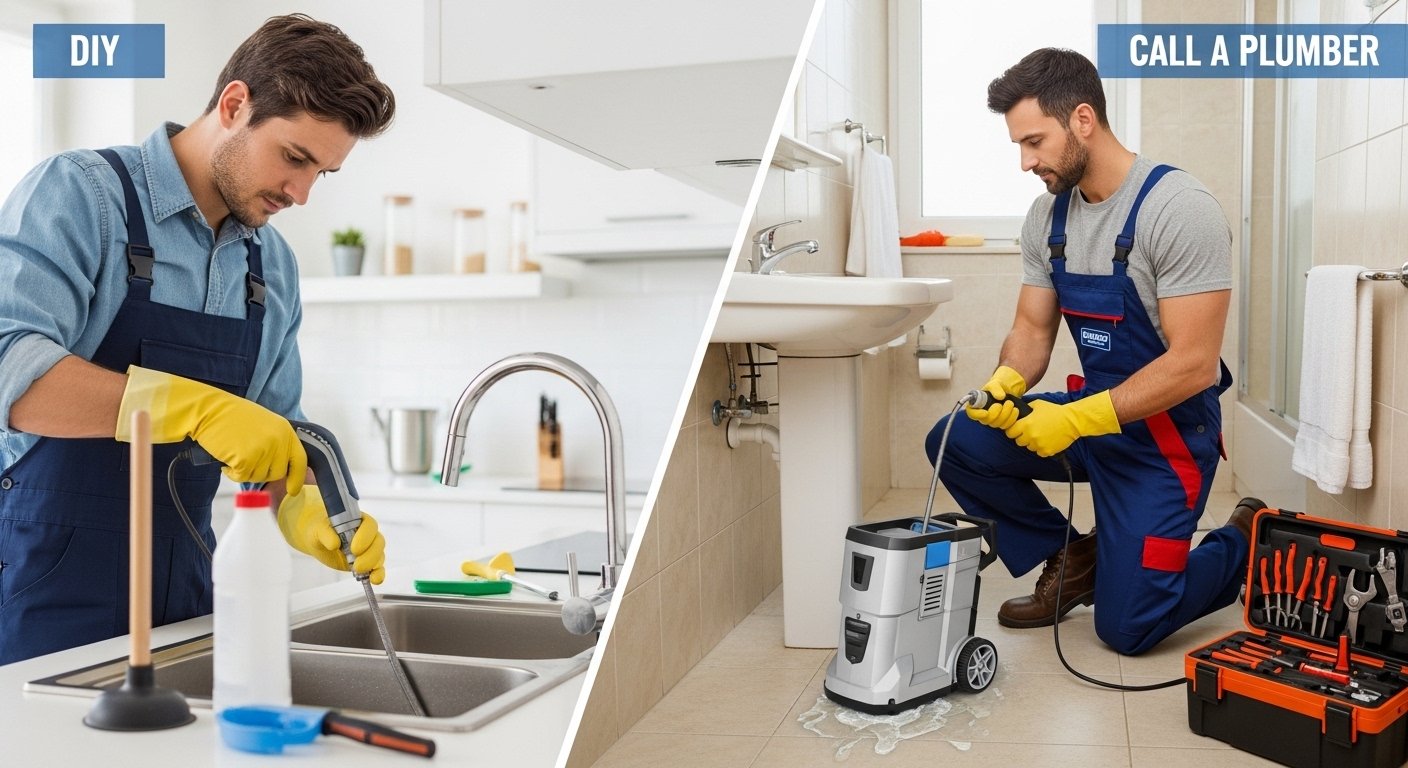
You are standing at the kitchen sink, watching water pool around your hands instead of draining away. Or you are stepping out of the shower and your feet are underwater by the time you reach for a towel. Every Bradenton homeowner has been there. Drain problems are one of those household headaches that feel minor — right up until they are not.
Here is something most people do not know: the way you respond to a clog in the first 24 hours often determines whether you spend $15 on a plastic drain snake or $600 on emergency repairs. This guide is going to walk you through every realistic scenario — what is likely going on in your pipes, which tools actually help, when DIY makes sense, and the specific warning signs that mean it is time to put the plunger down and pick up the phone.
We are also going to be honest about the stuff plumbers usually do not like to talk about — like why those popular liquid drain cleaners can quietly damage your plumbing for years before you ever notice. If you want a deeper look at what regular drain cleaning does for your home long-term, that is worth a read too. But for now, let us start at the beginning.
Why Drains Clog (And Why It Matters for Your Fix)
Before you grab any tool, it helps to understand what is actually causing the problem. Not all clogs are equal, and treating a deep blockage with a plunger is like trying to move a boulder with a feather duster.
The most common culprits in Bradenton homes break down like this:
- Hair and soap scum — The classic bathroom sink or shower clog. Hair combines with soap residue to form a sticky mass just below the drain cover. This is shallow, accessible, and usually fixable yourself.
- Grease and food buildup — Cooking grease that seems liquid when you pour it solidifies as it cools in your pipes. Over months, it accumulates like plaque in an artery. Kitchen drain clogs are often this type, and they sit deeper than people expect.
- Mineral deposits — Florida’s hard water leaves calcium and lime scale inside pipes over time. You will not notice until the flow slows significantly. This is not something any plunger will solve.
- Tree roots — In older Bradenton neighborhoods especially, tree roots creep toward pipes in search of moisture. Once they get in through a crack, they grow. This is a full professional job, no question.
- Foreign objects — Kids, guests, accidents. Things end up in drains that should not. The solution depends entirely on where the object lodged.
Knowing your clog type is step one. If you are not sure, pay attention to which drains are affected — that clue alone tells you a lot.
Your Three Real Options When a Drain Backs Up
Option 1: The Home Remedy (Plunger, Baking Soda, Vinegar)
These methods get dismissed a lot, but a proper plunger technique actually clears a surprising number of shallow clogs. The key word is “shallow.” If the clog is sitting in the top few inches of your drain trap, physical suction can dislodge it.
Baking soda followed by white vinegar creates a fizzing reaction that can break up mild soap and grease buildup. It will not power through a serious blockage, but as a monthly maintenance rinse, it genuinely helps prevent minor buildup from becoming a bigger problem.
- Best for: Hair clogs in bathroom sinks, light soap buildup, slow (not fully blocked) drains
- Cost: Essentially nothing — tools you already have
- Safe for pipes? Yes, completely
- Honest limitation: Will not touch grease, mineral scale, roots, or anything lodged deep in the line
Option 2: Retail Drain Snakes and Chemical Cleaners
The plastic “zip-it” tools you find at hardware stores for a few dollars are legitimately useful for one specific job: pulling hair out of a shower or bathroom drain. If that is your problem, they work great. Get one. Use it monthly.
Motorized drain snakes you can rent are a step up — they can reach further into the pipe and break through moderate clogs. They take some skill to use without scratching or damaging older pipes, but they are a reasonable tool for the confident DIYer.
Liquid chemical cleaners, though? This is where we need to have a real conversation.
The truth about liquid drain cleaners: Products like Drano and Liquid-Plumr work by generating a chemical reaction intense enough to dissolve organic material. That same heat and caustic reaction does not stop at the clog — it also degrades the pipe walls themselves. PVC can soften and warp. Cast iron corrodes faster. If the cleaner does not fully clear the blockage (which is common), you are left with a pool of active chemical sitting in your pipe that is dangerous for anyone who then tries to snake or service the drain manually. We have seen this cause genuine injuries. Use them sparingly if at all, and never pour in a second round if the first one did not work.
- Best for: Visible hair clogs you can pull out, moderate blockages you can reach
- Cost: $5–$50 depending on the tool
- Honest limitation: Chemical cleaners cause cumulative pipe damage; neither option handles deep or systemic clogs
Option 3: Professional Drain Cleaning
Professional drain cleaning involves two main methods: motorized augers and hydro-jetting. An auger (the professional version) physically breaks through blockages and pulls material out of the pipe. Hydro-jetting uses pressurized water to scour the interior walls of the pipe completely clean — not just poke a hole through the clog, but actually remove the buildup coating the walls.
Hydro-jetting in particular is the only method that genuinely restores a pipe to near-original flow capacity. It is also the standard approach for recurring clogs that keep coming back every few months despite DIY efforts. If you are dealing with that pattern, the clog is not really being cleared — it is being temporarily moved. Understanding the full benefits of professional drain cleaning helps explain why.
- Best for: Recurring clogs, multiple drains backing up simultaneously, foul odors, main line issues
- Cost: Upfront service fee, but far less than emergency repair or pipe replacement later
- Honest limitation: Not necessary for every small clog — save it for when the situation calls for it
The Real Decision Framework: 3 Questions to Ask Yourself
Here is the mental checklist we recommend. Work through these in order:
The 3-Strike Rule
- Is it just one drain? — If yes, this is likely a localized clog. DIY is a reasonable first attempt. If multiple drains are slow or backing up, that points to a main line problem. Call a professional.
- Have you tried a plunger twice without success? — Two honest attempts with proper technique and still no improvement? The clog is deeper or denser than surface tools can reach. Stop and call.
- Is there a strange smell or gurgling in other areas of the house? — Gurgling toilets when you run a sink, or foul sewer odors coming from floor drains, are signs of main line blockage or venting issues. These need professional diagnosis.
If you hit “yes” on any of questions 2 or 3, skip the DIY phase and call a licensed plumber.
Warning Signs You Should Never Ignore
Some drain symptoms look like minor inconveniences but are actually your plumbing system sending up a flare. Ignoring them often means a much bigger repair bill down the road.
| What You Notice | What It Likely Means | Action |
|---|---|---|
| Water backs up into shower when you flush the toilet | Main sewer line blockage | Call immediately |
| Multiple drains slow at the same time | Main line partial blockage | Call a plumber |
| Gurgling sounds from toilet or floor drain | Venting issue or deep blockage | Call a plumber |
| Recurring clog in same drain every 6–8 weeks | Tree roots or pipe damage | Camera inspection needed |
| Sewage smell indoors | Dry P-trap or main line issue | Diagnose promptly |
| Single drain, visible hair, slow but not blocked | Shallow hair clog | DIY first |
That last row — a single slow drain with a visible cause — is genuinely a DIY situation. We are not here to tell you to call a plumber every time you need to pull hair out of a drain cover. But the others? Those are signs of something systemic, and the longer you wait, the worse (and more expensive) they get.
Florida-Specific Factors That Change the Equation
Bradenton and the surrounding Manatee County area have plumbing considerations that homeowners in other parts of the country simply do not deal with.
Tree root intrusion is common. The tree canopy in many Bradenton neighborhoods is beautiful — and it is a constant threat to underground pipes. Oak, banyan, and ficus root systems are aggressive. If your home was built before 1990 and you keep having the same drain problems, there is a reasonable chance roots are involved. The only way to know for sure is a camera inspection. You can read more about how sewer camera inspections actually save money before a small problem becomes a collapsed pipe.
Hard water accelerates buildup. Florida’s water is notoriously hard. Mineral scale accumulates on the inside of pipes over the years, reducing flow and making clogs more likely. This is one reason we recommend professional drain cleaning on a regular schedule rather than waiting for a full blockage.
Older pipe materials still exist in many homes. Cast iron and galvanized steel pipes, common in homes from the 1950s through the 1980s, are far more vulnerable to chemical cleaners and corrosion. If your home is older, the aggressive DIY approach can backfire. A pipe replacement assessment for older homes might be worth considering if you are constantly fighting the same issues.
Wet season flooding adds pressure. Florida’s rainy season from June through September can overwhelm drain systems, especially if your sewer lateral or main line has any partial blockage already. Preparing your drainage before the wet season — not during a backup — is always the smarter move. Our guide on preparing your plumbing for Florida’s wet season covers this in detail.
How Often Should You Actually Clean Your Drains?
This varies by household, but as a baseline:
- Bathroom drains — Run a plastic zip tool through them monthly. Takes 90 seconds. It genuinely prevents the bulk of shower and sink clogs from ever developing.
- Kitchen drain — Pour boiling water down it weekly if you cook regularly. Avoid putting grease, coffee grounds, starchy foods, or fibrous vegetables down the disposal. And for what it is worth, your garbage disposal is not a substitute for a trash can — it makes grease buildup worse, not better.
- Whole-home professional cleaning — For most households in this area, once every two to three years is sufficient to prevent accumulation and catch any developing issues before they become emergencies. If you have an older home or large trees near your sewer line, consider annual service. The connection between regular drain cleaning and avoiding major clogs is worth understanding.
There is also a strong argument for pairing drain maintenance with a broader regular plumbing maintenance plan. Catching a slow drain, a dripping valve, or early water heater corrosion during a routine visit costs far less than an emergency call during a holiday weekend.
What Happens During a Professional Drain Cleaning Visit
A lot of homeowners do not know what to expect, so here is a straightforward breakdown of a typical service call:
- Diagnosis first. We do not just start feeding tools into pipes. We ask where the problem is, how long it has been happening, and whether it is recurring. Sometimes a few questions narrow the issue to a specific spot.
- Visual inspection. We check the accessible parts of the drain, look for obvious blockages near the surface, and assess the drain type and pipe material before selecting a method.
- Camera inspection if warranted. For recurring or multi-drain issues, we run a camera through the line. You get to see exactly what is in there — roots, grease, scale, or a collapsed section. No guesswork.
- Auger or hydro-jet. Depending on what we find, we clear the blockage using the appropriate method. Hydro-jetting for grease and scale, auger for roots or solid obstructions.
- Post-clear check. We confirm flow is restored and look for any signs of pipe damage that might need attention separately.
If you need a drain cleaning service in Bradenton or the surrounding area, that is what you can expect when you call us.
The Hidden Cost of Waiting
Here is something that rarely gets said plainly: slow drains do not stay slow. They get worse. And the timeline is unpredictable — a drain that has been sluggish for six months might run fine for another year, or it might fully block the night before Thanksgiving with a house full of guests.
Beyond the inconvenience, delayed action on drain issues creates real downstream costs:
- Standing water in drains accelerates corrosion in metal pipes
- Grease buildup that hardens becomes significantly harder and more expensive to remove than fresh buildup
- Undetected root intrusion that goes unchecked can fracture a pipe entirely, turning a drain cleaning job into a pipe repair or trenchless replacement
- Sewer gas from blocked vents or deteriorating seals is a genuine health issue, not just an odor problem
The math on preventive maintenance almost always favors acting earlier. If you are the kind of homeowner who prefers to stay ahead of these things, it is worth looking at what a plumbing maintenance contract actually covers — there is often more value there than people realize.
Common Questions We Hear
Are liquid drain cleaners really that bad for pipes?
Yes — more than most people realize. The caustic chemicals that dissolve clogs also degrade pipe materials over time. They generate significant heat inside the pipe and react with metal in ways that accelerate corrosion. PVC softens. Cast iron corrodes. And if the cleaner does not fully clear the clog, you now have a pool of active acid sitting in your pipe that is dangerous for any technician who needs to access it afterward. Occasional use on PVC pipes in good condition is low risk, but repeated use — especially in older homes — is quietly destructive.
Can I put coffee grounds down the sink?
Please do not. Coffee grounds do not dissolve and they behave like wet sand in your drain — they accumulate and compact into a dense mass that is stubborn to remove. Compost them, or throw them in the trash.
How do I know if it is a main line problem vs. a single drain problem?
The clearest sign of a main line blockage is when multiple drains in the house are affected simultaneously, or when using one fixture causes backup in another. A toilet that gurgles when you run the bathroom sink is a classic example. Single-fixture clogs stay contained — if flushing the toilet causes no reaction in the shower drain, your main line is almost certainly fine.
I have a newer home — do I still need professional drain cleaning?
Newer homes are not immune. Grease, hair, and soap buildup accumulate regardless of pipe age. What newer homes have going for them is that the pipes are less likely to have pre-existing corrosion or root damage — so the baseline risk is lower. A cleaning every three years or so is still a reasonable preventive measure, especially in kitchens with heavy use. If you are curious about your overall plumbing health, a plumbing inspection gives you a full picture without waiting for a problem to develop.
What if I used a chemical cleaner and it did not work?
Stop. Do not pour more in. At this point, there is active chemical sitting in your pipe — adding more increases the concentration and the risk. Let what you have used sit and drain for at least an hour, then call a professional. Let them know you used a chemical cleaner so they can take appropriate precautions. This is important for the technician’s safety.
Final Thoughts: Expert Tips for Drain Maintenance
Most drain problems in Bradenton homes start small and stay manageable with basic maintenance. A monthly habit of pulling hair from shower drains, keeping grease out of the kitchen sink, and running hot water after each use will prevent the majority of clogs from ever forming in the first place.
When a clog does develop, use the 3-Strike Rule. One drain, visible cause, plunger or zip tool — go ahead and try it yourself. But the moment you see multiple drains affected, recurring clogs in the same spot, water backing up from unexpected places, or strange gurgling you have never heard before, that is when to call. Those are not signs of a minor inconvenience. They are signs of something deeper that is going to cost more the longer you wait.
Redemption Plumbing Services serves Bradenton and the broader Manatee and Sarasota counties around the clock. We are local, licensed, and direct about what your home actually needs — not what generates the biggest invoice. Whether you need a quick drain cleaning or a thorough sewer camera inspection in Bradenton, we are a call away.
Your plumbing should just work. When it does not, now you know exactly what to do about it.

Comments are closed