


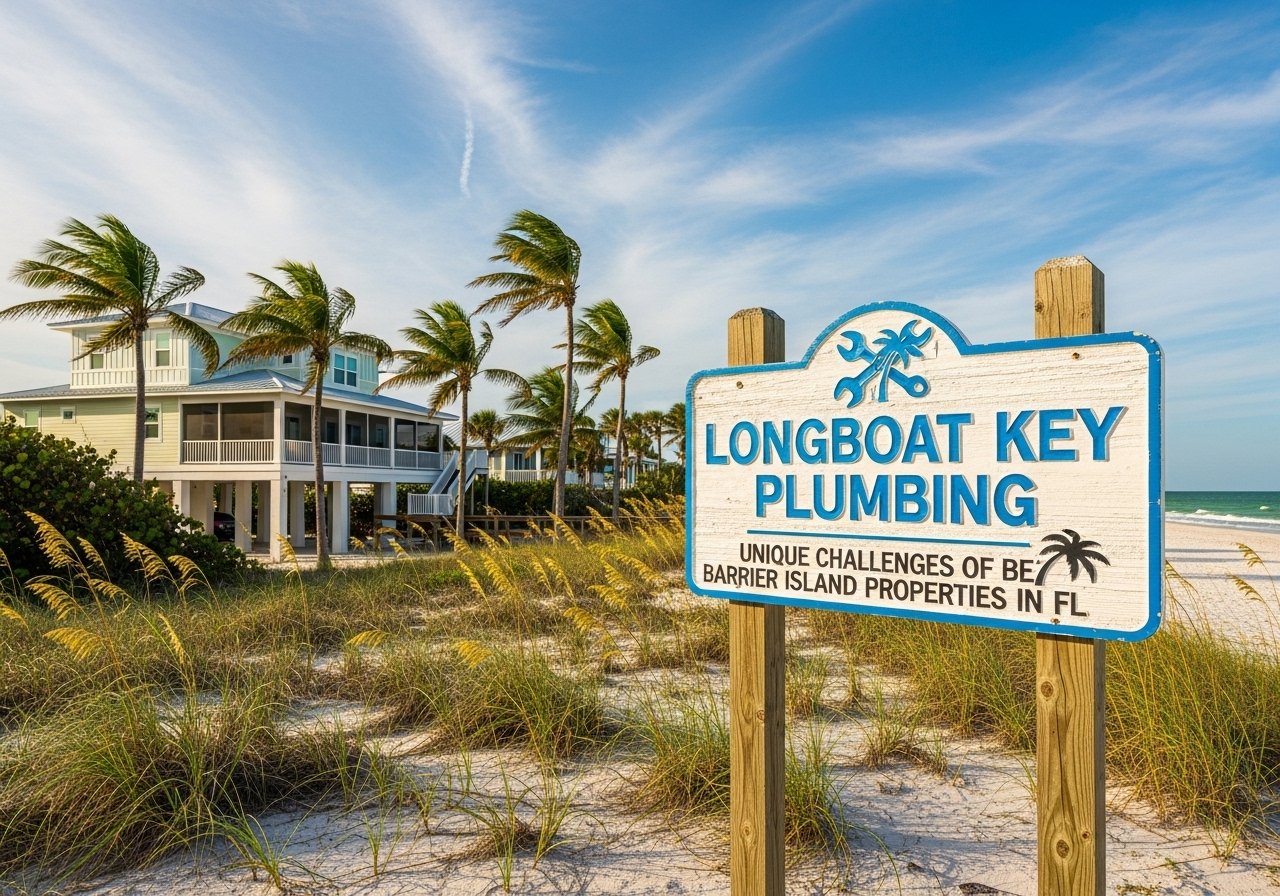
Longboat Key is one of Florida’s most breathtaking barrier islands — a narrow strip of white sand and swaying palms nestled between Sarasota Bay and the Gulf of Mexico. It’s a paradise for residents and vacationers alike. But beneath the sun-soaked beauty lies a set of plumbing challenges that are entirely unlike anything found on the mainland. If you own or manage a property here, understanding the unique forces working against your plumbing system is the first step toward protecting your investment.
Barrier island plumbing doesn’t just face ordinary wear and tear. It faces salt air, shifting soils, tidal fluctuations, a notoriously high water table, and the constant humidity of the Gulf Coast. Every single one of these factors accelerates the deterioration of your pipes, fixtures, and drainage systems. In this guide, we’ll break down the real technical challenges of Longboat Key plumbing services and explain exactly why island properties demand a specialized approach — and a plumber who truly understands the territory.
Why Barrier Island Properties Are Plumbing’s Hardest Test
Before diving into the specific issues, it’s worth understanding what makes a barrier island different from a typical inland property in Florida. Barrier islands are dynamic geological formations. They are narrow, low-lying, and surrounded by water on both sides. The soil beneath them is primarily sand and shell, which drains well in some respects but offers very little structural support for buried infrastructure.
The proximity to the Gulf of Mexico and Sarasota Bay means that tidal cycles, storm surges, and seasonal flooding are recurring realities. The atmosphere is saturated with salt — not just at the shoreline, but several blocks inland as well. Wind carries salt spray onto exposed pipes, fittings, and water heater components. This environment is corrosive by nature.
What this means practically is that the standard lifespan of plumbing components on Longboat Key is considerably shorter than the manufacturer’s stated expectations. Pipes that would last 50 years on the mainland may corrode in half that time. Water heaters that perform reliably for 12 years inland may show significant degradation in 7 or 8 years on the island. Everything moves faster in a coastal environment.
Challenge #1 — Salt Air Corrosion and Galvanic Deterioration
One of the most persistent enemies of Longboat Key plumbing is salt air corrosion. When salty, humid air makes contact with metal plumbing components — whether exposed above the slab or buried in the ground — it initiates oxidation at an accelerated rate. This is especially problematic for homes built in the 1970s, 1980s, and 1990s, many of which still contain original copper or galvanized steel piping.
Galvanic corrosion is a related but distinct problem. It occurs when two dissimilar metals come into contact in the presence of an electrolyte — in this case, salty moisture. On Longboat Key, this commonly happens at connection points where copper pipe meets steel fittings, or where brass valves connect to older iron supply lines. The result is an electrochemical reaction that eats through the metal over time, creating pinhole leaks that are difficult to detect until they’ve already caused significant water damage.
This is precisely why professional leak detection and repair is so critical on barrier island properties. Pinhole leaks behind walls or beneath flooring often go unnoticed for months. By the time the homeowner spots a stain on the ceiling or a warm patch on the floor, the moisture has typically been accumulating long enough to foster mold growth and weaken the structural integrity of the surrounding materials.
When replacing corroded pipe sections, experienced coastal plumbers choose materials specifically rated for high-humidity, high-salinity environments. Cross-linked polyethylene pipe (PEX-A) and certain grades of CPVC have become the preferred choices for Longboat Key repiping projects because they resist the chemical degradation that destroys metal piping over time.
Challenge #2 — The High Water Table Problem
Longboat Key sits at an elevation of just a few feet above sea level. In some areas of the island, the water table is less than two feet below the surface. This has profound implications for any plumbing that exists underground — which, of course, includes your sewer lines, drain lines, and water service connections.
When the water table is this high, buried pipes face a phenomenon called hydrostatic pressure — external water pressure pushing inward against pipe walls. Over time, this pressure can cause plastic or clay sewer pipes to crack, compress, or shift at the joints. Even PVC pipes, which are generally resilient, can experience joint separation when the soil around them is constantly saturated and shifting.
A high water table also raises the risk of root intrusion in a counterintuitive way. Tree and shrub roots naturally seek moisture, and in sandy island soils, the paths of least resistance often run directly alongside buried pipe walls. When roots breach a sewer line joint weakened by hydrostatic stress, they can grow rapidly inside the pipe, causing partial or complete blockages.
This is one reason why main sewer line services on Longboat Key often involve more than simple snaking. A thorough sewer camera inspection is essential to assess the actual condition of the line, identify offset joints, root intrusions, or bellied sections, and determine the best repair approach before problems escalate into sewage backups.
Challenge #3 — Slab Leaks Under Coastal Foundations
Many Longboat Key homes were built on concrete slab foundations — a practical choice for Florida’s flat terrain. However, slab foundations conceal a significant plumbing vulnerability. The hot and cold water supply lines run through or beneath the concrete slab, and in a coastal environment, these lines are under constant stress from shifting sandy soils, thermal expansion, and corrosion.
A slab leak occurs when one of these buried lines develops a failure — whether from corrosion, joint separation, or abrasion where the pipe contacts the concrete. The leak is hidden entirely beneath solid concrete, and the water has nowhere to go except upward through the slab and into your home. Early warning signs include unexplained increases in your water bill, warm or wet spots on floors, the sound of running water when all fixtures are off, or visible cracks appearing in the foundation.
Left unaddressed, slab leaks on Longboat Key can be particularly damaging. The sandy soil beneath the slab washes away as water saturates it, creating voids that undermine the structural support of the foundation itself. This is a situation where prompt, expert intervention is not optional — it’s essential.
Modern acoustic and thermal leak detection technology allows skilled plumbers to pinpoint the exact location of a slab leak without breaking up the entire floor. Once located, the repair options include direct access through the slab, pipe rerouting above the slab, or in some cases, trenchless pipe repair methods that line the interior of the damaged pipe without excavation. On an island where landscape disruption is particularly costly and undesirable, trenchless methods are often the most practical solution.
Challenge #4 — Water Heater Stress in Saltwater Climates
Water heaters on Longboat Key work harder and fail sooner than their mainland counterparts. There are two primary reasons for this. First, the salt air attacks the external components of the heater — the venting system, the pressure relief valve, the gas connections (if applicable), and the body of the unit itself. Rust and corrosion on these components can create safety hazards as well as performance issues.
Second, Sarasota County water — while treated — carries a moderate level of mineral hardness. In a tank-style water heater, this mineral content precipitates out as sediment on the bottom of the tank when water is heated. Over time, sediment buildup reduces heating efficiency, forces the burner or heating element to work harder, and accelerates the breakdown of the tank lining. In coastal homes that sit vacant during off-season months, stagnant water inside the tank can also accelerate internal corrosion.
Routine maintenance — including annual tank flushing, anode rod inspection, and exterior component checks — significantly extends the life of a water heater on Longboat Key. Many island homeowners are also making the switch to tankless water heaters, which eliminate the sediment buildup issue entirely and are far more compact, allowing for better ventilation placement away from salt air exposure. Proper water heater services performed by a plumber familiar with coastal conditions make a meaningful difference in unit longevity.
Challenge #5 — Drain and Sewer Backups From Tidal Influence
Living at or near sea level means that Longboat Key’s drainage systems are perpetually influenced by tidal cycles. During high tide events — and especially during storm surge situations — the outfall elevations for municipal sewer systems can be temporarily submerged or pressurized. This can reduce the natural gravity drainage from individual properties and in some cases cause partial backflow into lower-lying drain lines.
For individual homeowners, this means that floor drains in ground-level garages or laundry rooms, as well as lowest-floor bathroom fixtures, are vulnerable to backflow during heavy rain or storm events. Backflow prevention devices — specifically check valves and backwater valves installed on sewer laterals — are an important but often overlooked protective measure for island properties.
Additionally, the salt and mineral content in Longboat Key’s water supply contributes to a faster buildup of scale and deposits inside drain lines. In kitchens especially, the combination of cooking grease and mineral scale creates a sticky, progressive blockage that standard drain snaking often cannot fully clear. Hydro-jetting — a process that uses high-pressure water streams to scour the interior walls of drain pipes — is far more effective for these conditions and provides a longer-lasting result. Professional drain cleaning services using hydro-jetting are worth scheduling annually for coastal properties prone to mineral buildup.
Challenge #6 — Seasonal Vacancy and Plumbing Dormancy Issues
A significant portion of Longboat Key’s housing stock is used seasonally — as winter residences, vacation rentals, or investment properties that sit vacant during Florida’s slower summer months. Plumbing systems that go dormant for extended periods face a distinct set of problems that year-round residents typically don’t encounter.
When water sits stagnant in pipes for weeks or months, sediment settles, mineral deposits harden, and the risk of microbial growth inside the system increases. Rubber components — flappers, washers, supply line hoses, and wax ring seals — can dry out and crack when they’re not kept moist through regular use. Upon return to the property, homeowners sometimes discover that faucets drip, toilets run constantly, and supply hoses under sinks or behind toilets have developed micro-cracks.
Before leaving a property vacant for an extended period, and before returning to open it up for the season, a professional walkthrough by a qualified plumber is one of the most valuable preventive steps an island property owner can take. Checking supply line integrity, testing the water heater’s temperature and pressure relief valve, running all drains to clear any settled debris, and inspecting shut-off valves for seize-up are all tasks that prevent much larger problems down the road.
The Importance of Working With Locally Experienced Plumbers
Given everything outlined above, it should be clear that Longboat Key plumbing is not a job for a generalist. The challenges are specific, the environment is unforgiving, and the consequences of inadequate repairs can be both expensive and structurally serious. A plumber who understands barrier island conditions — who knows which pipe materials hold up in saltwater atmospheres, who recognizes the signs of hydrostatic soil failure, and who is familiar with Sarasota County’s local building codes for coastal construction — is an entirely different resource than one who has never worked on an island property.
When issues do arise — as they inevitably will with coastal plumbing — having an established relationship with a trusted local plumbing company means faster response, more accurate diagnosis, and repairs that are designed to last in the actual conditions your property faces. For expert Longboat Key plumbing services tailored to the specific demands of barrier island properties, Redemption Plumbing Services brings the local knowledge, technical capability, and coastal-appropriate materials that island homeowners need.
Protecting Your Longboat Key Property: A Proactive Approach
Rather than waiting for a plumbing failure to force action, barrier island homeowners benefit enormously from a proactive maintenance mindset. This means:
- Scheduling annual sewer camera inspections to catch root intrusion or joint deterioration before it causes a backup
- Flushing water heaters every 12 months and replacing anode rods as needed
- Having exposed pipe connections checked for early-stage galvanic corrosion
- Testing backflow prevention devices annually to ensure they’re functioning properly
- Running all fixtures and drains during seasonal property opening procedures
- Replacing aging galvanized or copper supply lines with corrosion-resistant PEX-A before they fail
These steps aren’t just about preventing inconvenience — they’re about protecting the long-term value of a property that represents a significant investment. On Longboat Key, where real estate values are substantial and the environment is persistently challenging, preventive plumbing care is genuinely one of the most financially sound decisions a property owner can make.
Final Thoughts
Longboat Key is a spectacular place to live or own property — but it demands a different level of care than the mainland. The salt air, the high water table, the tidal influences, the shifting sandy soils, and the seasonal use patterns of island properties all combine to create plumbing challenges that require genuine expertise and locally specific knowledge.
Understanding these challenges is the first step. The second is partnering with a plumbing team that has demonstrated experience with barrier island conditions, uses the right materials for coastal environments, and provides transparent, honest service without shortcuts. Because on Longboat Key, the ocean is beautiful — but it’s also working against your plumbing every single day.


Comments are closed