


Slab Leak Detection in Bradenton, FL: Warning Signs to Watch For
Picture this: you wake up one Tuesday morning, shuffle to the kitchen, and notice the floor feels… warm. Not like “the sun’s been hitting it” warm. More like “something is wrong” warm. You check the water bill that came last week — it’s $80 higher than usual, and you haven’t done anything differently. You’re not running extra laundry. You didn’t fill a pool. So what gives?
This is almost exactly how most slab leak stories start.
Not with a burst pipe or a dramatic flood. Just a vague, nagging feeling that something’s off. And if you live in Bradenton — or anywhere in Southwest Florida, really — that instinct is worth paying attention to. The conditions here make slab leaks more common than most homeowners realize, and catching one early can be the difference between a manageable repair and a full-blown foundation nightmare.
So let’s talk about what’s actually happening under your feet, how to spot it, and what you should do if you think you’ve got one.
First — What Even Is a Slab Leak?
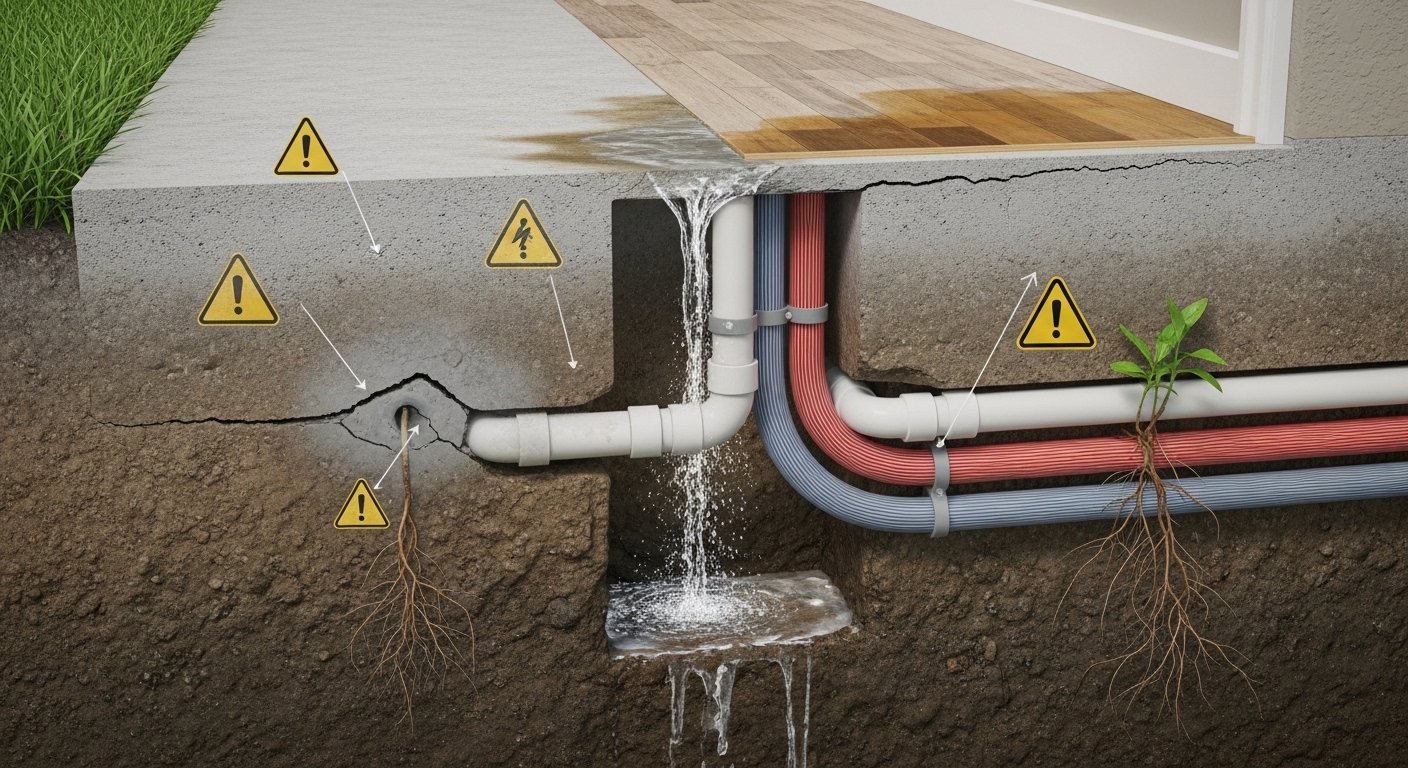
Your home sits on a concrete foundation. And running through (or underneath) that slab are water supply and drain pipes. When one of those pipes develops a leak, you’ve got a slab leak.
The tricky part? You can’t see it. The water is escaping underground, often slowly, sometimes for weeks or months before it becomes obvious. By the time you notice something, the damage has usually already started.
Here’s what makes Bradenton homes especially vulnerable: the soil here shifts. Florida’s sandy, moisture-rich ground expands and contracts with rain and dry spells. Over years, that movement puts stress on pipes that were never designed to flex. Add in the fact that many homes here were built in the 70s and 80s with copper pipes — which corrode in our high-mineral water — and you’ve got a recipe for trouble.
The Warning Signs: What to Actually Watch For
1. Your Water Bill Spiked and Nothing Changed
This is the big one. If your bill jumped $50, $80, even $100+ in a month and you can’t explain it, a slab leak is one of the first things to rule out.
The math is pretty straightforward: a slow, steady leak running 24/7 adds up fast. You’re not going to catch it by looking around the house, but your water meter tells the whole story.
Here’s a quick check you can do right now: Turn off every faucet and water-using appliance in your home. Go find your water meter and watch it for 10-15 minutes. If the dial is still moving — or if you check the reading, wait an hour, and it’s changed — water is going somewhere it shouldn’t be.
2. Warm or Hot Spots on Your Floor
Remember that warm floor feeling from the opening? That’s a classic hot water line leak. When hot water escapes under your slab, it heats the concrete from below, and eventually you can feel it through your tile or flooring.
This one tends to be more obvious with tile floors than carpet (carpet insulates more), so if you’ve got a mix of flooring types, run your hand or your bare foot across the tile in areas like the kitchen, bathroom, or hallway.
3. The Sound of Running Water (When Nothing’s On)
This is honestly one of the more unsettling signs. You’re sitting in your house in the evening, everything’s quiet, and you can faintly hear… water moving. Sometimes it sounds like a hiss. Sometimes more like rushing water behind a wall.
Trust that sound. Your pipes shouldn’t make noise when you’re not using them.
4. Cracks in Your Floors or Walls
Here’s where it gets serious. When water seeps into the soil under your foundation over time, it changes how that soil supports your slab. Sections can shift. And when the foundation moves, cracks show up — first in the concrete, then in your drywall, sometimes in your tile grout.
Not every crack means a slab leak (Florida houses settle normally too), but if you’re seeing new cracks show up alongside some of the other signs on this list, the connection is worth investigating.
5. Low Water Pressure Out of Nowhere
You wake up one morning, hop in the shower, and the water pressure’s noticeably weaker than usual. You haven’t changed anything. But somewhere along the line, water is escaping before it gets to your fixtures. That’s why the pressure is dropping.
This one can also signal other issues — a failing pressure regulator, a problem at the meter — but combined with other symptoms, it’s a red flag worth taking seriously.
6. Wet Spots, Soft Ground, or Puddles With No Explanation
Outside, along the perimeter of your home or in your yard: do you notice areas that stay perpetually wet? Grass that’s unusually green in one patch? Mud where there shouldn’t be any?
Same goes for inside — damp baseboards, soft spots in your flooring, or moisture on your carpet that you can’t trace back to a spill.
These are signs water is migrating upward, looking for somewhere to go.
7. Mold or Mildew Smell Without a Visible Source
Florida humidity means mold is already a thing you think about. But there’s a difference between surface moisture and a persistent, earthy smell that seems to come from the floor or walls without any obvious source.
When water leaks slowly and consistently under your slab, it creates ideal conditions for mold to grow — and you’ll often smell it before you see it.
Why Florida Makes This Worse (Honestly)
Look, I don’t want to scare you into thinking every Florida home is a ticking time bomb. But the combination of factors here is real:
The soil moves. Sandy, expansive soil in Southwest Florida shifts with rain and drought cycles. That movement stresses pipes over decades.
The water’s hard. Bradenton’s water has higher mineral content than many parts of the country. Those minerals deposit inside copper pipes, slowly corroding them from the inside out.
The homes are aging. A lot of Bradenton’s residential neighborhoods were developed in the 60s through the 80s. That means a lot of homes have original copper plumbing that’s now 40-60 years old. That copper has had a long time to wear down.
The climate stays warm. Unlike colder climates where freezing and thawing creates obvious, dramatic pipe failures, Florida leaks tend to be slow and subtle. There’s no hard freeze to force the issue. So a small leak can keep going… and going… without ever announcing itself dramatically.
What Happens If You Ignore It
I want to be direct here: slab leaks don’t heal themselves.
A small, slow leak has a way of becoming a medium leak, then a serious one. The water saturates the soil around your foundation. That weakens the concrete’s support. Foundation movement causes structural cracks. Meanwhile, the moisture that’s wicking up through your slab creates the perfect environment for mold — inside your walls and under your floors where you can’t easily see it.
The repair costs scale up significantly the longer a leak goes undetected. Catching it early — when it’s still just a pipe problem — is the best case scenario. Waiting until you’ve got foundation damage and mold remediation on top of the plumbing repair is a much more expensive conversation.
If you’re seeing these signs and wondering whether to call someone, that wondering is your answer.
What a Professional Diagnosis Actually Looks Like
When you bring in a qualified plumber to investigate a suspected slab leak, here’s what actually happens — because a lot of people don’t know what to expect:
Pressure testing — The plumber will shut off sections of your plumbing and pressurize them to identify where pressure is dropping. This helps pinpoint which line is leaking.
Electronic leak detection — Specialized equipment can listen for the acoustic signature of water escaping under pressure, even through concrete. This is how pros locate a leak before they start cutting anything.
Thermal imaging — Infrared cameras show temperature differences in your floor. Hot water leaks show up as warm zones. It’s kind of remarkable to see, honestly.
The goal is to find exactly where the leak is before any demo work starts. That precision matters — it keeps the repair targeted and minimizes how much of your floor or foundation has to be opened.
For pipe repair or replacement in Bradenton, working with someone who uses these diagnostic tools (not just guesswork) is really the only way to go. The difference in outcome between a targeted repair and a “we’ll figure it out when we open it up” approach is significant.
Expert Insight: What We See Again and Again
After working on plumbing in Southwest Florida homes for years, a few patterns come up constantly:
The homeowners who fare best are the ones who acted on a nagging feeling early — a bill that seemed off, a floor that felt weird — rather than waiting for obvious damage.
The hardest conversations are with homeowners who knew something felt wrong for months but kept hoping it would resolve on its own. It never does.
Older homes with original copper supply lines in areas with a history of high water bills are almost always worth a professional inspection, even without dramatic symptoms. Proactive is so much cheaper than reactive.
And honestly? The diagnostic part — finding the leak — is where a lot of the value is. Once you know exactly what you’re dealing with and where, the path forward is clear. It’s the not-knowing that’s stressful.
What to Do Right Now If You’re Worried
Here’s a practical sequence:
Step 1 — Do the meter test. Turn everything off and watch your water meter for 15-20 minutes. If it moves, you’ve got a leak somewhere.
Step 2 — Walk your home. Bare feet are helpful here. Feel for warm spots on tile floors, especially in hallways and bathrooms. Check baseboards for moisture. Sniff for musty smells near the floor.
Step 3 — Pull your last 3-6 water bills. Is there a trend? A sudden jump? That data is genuinely useful for a plumber trying to understand how long a potential leak has been going.
Step 4 — Call a plumber. If any of this is adding up, don’t keep investigating on your own. Modern detection equipment will find what you can’t.
A good plumber won’t try to scare you into a repair you don’t need. They’ll show you what they’re finding and explain your options. If you want a straight answer on what’s happening under your home and what it’ll take to fix it, Redemption Plumbing works with Bradenton homeowners on exactly these kinds of situations.
Frequently Asked Questions
How much does it cost to fix a slab leak in Florida? It genuinely varies — a lot. A simple repair on a single accessible pipe might run $500-$1,500. If there’s extensive pipe damage, foundation issues, or mold involved, costs can go into the $5,000-$15,000+ range. This is exactly why early detection matters: the leak itself is almost always cheaper to fix than the downstream damage.
Can I live in my home while a slab leak gets repaired? Usually yes, for most repairs. If the repair requires significant jackhammering or your water needs to be shut off for extended periods, you might need to make other arrangements for a day or two. Your plumber should walk you through the timeline before starting.
Is a slab leak covered by homeowner’s insurance? Sometimes. Most policies cover the damage caused by a sudden, unexpected leak — but not necessarily the repair to the pipe itself. And coverage can get complicated if the insurer determines the leak had been going on for a while (suggesting the homeowner should have caught it earlier). Worth a call to your insurance company once you know what you’re dealing with.
How long does slab leak detection take? A full diagnostic inspection — pressure testing plus electronic leak detection — typically takes 2-4 hours. The accuracy that process provides is worth the time.
What’s the difference between repairing and repiping? A repair fixes the specific damaged section of pipe. Repiping replaces all (or most) of your supply lines, usually running them through walls and the attic to bypass the slab entirely. If a home has older copper pipes and has had multiple leaks, repiping is often the smarter long-term investment rather than playing whack-a-mole with repairs.
The Bottom Line
If you’ve made it this far because something felt off about your home — trust that. Slab leaks in Bradenton are genuinely common, and they’re almost always quieter than you’d expect until they’re not.
The good news: they’re fixable. And the earlier you catch one, the simpler and less expensive the fix tends to be.
So do the meter test. Walk your floors. Check those water bills. And if things aren’t adding up, make the call. Your foundation — literally — will thank you.
If you’re concerned about a possible slab leak or water line issue in your Bradenton home, Redemption Plumbing Services offers professional diagnostics and pipe repair in the Bradenton area. No pressure, just answers.


Comments are closed