


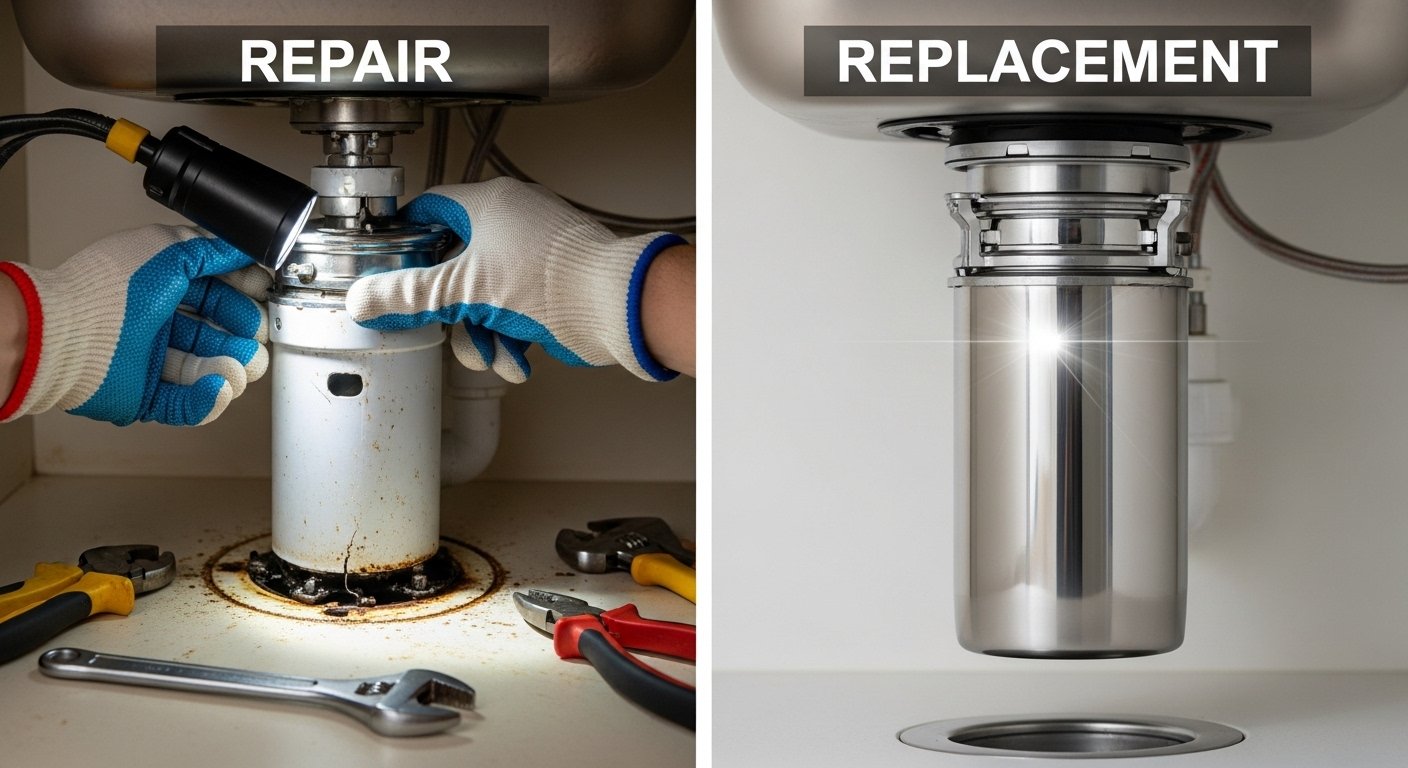
Garbage Disposal Repair vs. Replacement in Bradenton FL — What Makes Sense?
The garbage disposal dies at the worst possible moment. It’s always after dinner, always when there’s a sink full of dishes, always when you’re already tired. There’s that grinding halt — or worse, no sound at all — and suddenly you’re standing over a sink that smells like last week and wondering: do I fix this thing or just replace it?
It’s a genuinely confusing decision. Because sometimes repair is the smart move and you’d be throwing money away on a brand-new unit. And sometimes the disposal is so far gone that paying to fix it is just delaying the inevitable by six months.
This guide walks you through how to actually make that call — step by step, without the guesswork. We’ll cover what’s probably wrong, what you can try yourself, when it’s worth calling someone, and what real replacement costs look like in Bradenton in 2025.
If you’d rather just have someone come out and take a look, garbage disposal services in Bradenton are available — but honestly, read this first. You might be able to fix it yourself in about ten minutes.
Before You Do Anything: What You Actually Need to Know
This isn’t a section you skip. A garbage disposal issue can usually be diagnosed fairly accurately just from how it’s failing — which tells you a lot about whether repair or replacement makes sense before you even pick up a tool.
What type of failure are you dealing with?
There are really three categories:
- Won’t turn on at all — no hum, no noise, completely silent
- Hums but won’t grind — motor is getting power but the grinding plate isn’t spinning
- Runs but works poorly — slow grinding, frequent jams, leaking, or bad odors that won’t clear
Each of these points toward different causes and different solutions. Knowing which one you have saves you from trying the wrong fix.
How old is the disposal?
This is the other big variable. Most garbage disposals have a lifespan of 8–15 years depending on the brand and how it’s been used. If yours is under 8 years old, repair almost always makes sense if the problem is fixable. If it’s over 12 years old and failing for the second or third time, replacement is usually the honest answer.
What brand and horsepower are you working with?
Entry-level 1/3 HP disposals are inexpensive to replace but have limited repairability — parts are sometimes hard to find and labor can approach the cost of a new unit quickly. Mid-range 1/2 to 3/4 HP units from brands like InSinkErator or Moen are worth repairing if the problem is mechanical. Heavy-duty 1 HP units are generally worth repairing as long as the motor hasn’t failed.
Step 1: Check the Reset Button Before Anything Else
I’m going to say this plainly because it saves a lot of embarrassment: the single most common garbage disposal “failure” is a tripped thermal overload. And the fix takes literally fifteen seconds.
Under your disposal unit, on the bottom, there’s a small red or black button. That’s the reset button. When the disposal overheats or jams hard, it trips this switch to protect the motor. It doesn’t always pop out visibly — sometimes it just trips internally.
Press it in firmly. You might feel a slight click. Then run the water and try the disposal again.
If it works: you’re done. The disposal was fine. It jammed, overheated, reset itself — totally normal.
If it trips again quickly: there’s an ongoing jam or mechanical issue to address.
Pro tip: Before pressing reset, always run your hand (carefully) under the sink and make sure the disposal isn’t hot to the touch. If it’s warm from an overload, give it 10–15 minutes to cool before resetting.
[IMAGE: Underside of garbage disposal unit showing the red reset button location, with an arrow pointing to it clearly]
Step 2: Check the Allen Wrench Port for a Jam
If the disposal hums but won’t spin — or if it won’t start at all even after reset — there’s a good chance the grinding plate is jammed.
Look under the disposal for a hex-shaped socket port in the center of the bottom plate. Most disposals ship with a small Allen wrench (usually 1/4 inch) specifically for this. If you’ve lost it, any Allen wrench set will work.
Insert the wrench and work it back and forth. You’ll feel the plate break free if there’s a jam. Once it moves freely, remove the wrench, press reset again, and try the disposal.
What you’re looking for while you’re down there:
- Does the plate move freely in both directions?
- Can you hear or feel anything grinding that shouldn’t be there?
- Is there any visible debris or object that might have fallen in?
If the plate moves freely but the disposal still hums without spinning, the problem is likely the motor coupling or the motor itself — and that’s usually a replacement conversation, not a repair one.
Warning: Never reach into the disposal opening, even when it’s off. Use tongs or pliers to fish out any foreign objects. This is how hands get hurt.
[IMAGE: Underside of disposal showing Allen wrench being inserted into the hex port, with correct angle and positioning visible]
Step 3: Clear Any Foreign Objects from the Chamber
Jams caused by actual objects — a bone fragment, a piece of glass, a utensil that slipped in — are straightforward to fix but require care.
Turn off the disposal at the switch. Then turn off the power at the circuit breaker. Don’t skip the breaker step.
Use a flashlight to look into the disposal from above. If you can see an object, use tongs or needle-nose pliers to retrieve it — not your hand. Once the chamber is clear, restore power, press reset, and test.
If you’re clearing debris regularly (more than once a month), that’s a behavior problem, not a disposal problem. Florida households that use the disposal heavily for fibrous vegetables, citrus peels, coffee grounds, and similar items tend to jam more frequently. More on what not to put down the disposal in the expert tips section.
Step 4: Diagnose a Leak — and Decide if It’s Worth Fixing
Garbage disposal leaks are common and fall into a few specific locations. Where the leak is coming from tells you whether repair makes sense.
Leak from the top (where the disposal meets the drain flange): This is usually a failed plumber’s putty seal around the sink flange. It’s repairable and not expensive — either DIY with some patience or a quick service call. Not a reason to replace the unit.
Leak from the side (at the dishwasher connection or drain outlet): Usually a failed gasket or loose connection. Also repairable, and relatively straightforward.
Leak from the bottom of the unit: This one is different. A leak from the bottom means the internal seals have failed — and internal seal failure on a garbage disposal isn’t really repairable in a practical sense. You’d be pulling the unit to try to rebuild it, at which point you’re spending labor money on a unit that’s already showing its age. This is typically a replacement signal.
[IMAGE: Diagram showing three leak locations on a garbage disposal — top flange, side connection ports, and bottom of unit — with labels indicating which are repairable vs. signs to replace]
Step 5: Evaluate Persistent Odors That Won’t Clear
Bad smell coming from the disposal isn’t always a mechanical problem — but it can indicate one.
Most disposal odors are just food buildup inside the chamber and on the grinding components. You can usually clear these with ice cubes (which scour the chamber), a handful of coarse salt, or citrus peels run through on a cold water cycle. If that fixes it, you’re good.
If the smell persists after thorough cleaning, or if you’re getting a sulfur or sewage odor rather than a food smell, the problem might be in the drain line rather than the disposal itself. Particularly in older Bradenton homes where drain lines can have buildup or partial blockages, a disposal odor is sometimes the drain talking, not the unit.
In that case, a plumber can snake or hydro-jet the kitchen drain line. It’s a different problem than the disposal.
Step 6: Make the Repair vs. Replace Decision
Here’s the honest framework. You’ve diagnosed the problem — now let’s match it to the right answer.
| Problem | Repair or Replace? | Notes |
|---|---|---|
| Trips reset repeatedly | Repair — clear the jam | If motor seems sluggish, assess age |
| Hums but won’t spin (jam cleared) | Usually replace | Motor coupling or motor failure |
| Top or side leak | Repair | Inexpensive fix, worth doing |
| Bottom leak | Replace | Internal seal failure, not cost-effective to repair |
| Frequent jams, unit over 10 years | Replace | End of service life, not worth investing in |
| Slow grinding, unit under 8 years | Repair | Blade sharpening or plumber’s assessment |
| Complete silence, reset doesn’t help | Check outlet first, then assess | Could be electrical; rule that out first |
| Unit over 12 years, any significant issue | Replace | Be honest about the math |
The math on repair vs. replace in Bradenton:
A professional service call for garbage disposal repair typically runs $80–$200 depending on what’s needed. A mid-range replacement disposal (1/2 HP, good brand) costs $150–$300 for the unit, plus $100–$200 for installation. So total replacement is usually in the $250–$500 range for a solid mid-tier unit.
If a repair is going to cost more than half of what replacement would cost — and especially if the unit is more than 8–10 years old — replacement wins on basic math. You get a warranty, you get better performance, and you’re not putting money into something that’s likely to fail again soon.
Troubleshooting: When the Obvious Fixes Don’t Work
Reset works, but disposal trips again within a few uses: The motor is working harder than it should — often because of partial jam that wasn’t fully cleared, worn grinding components, or a motor that’s starting to go. Have it assessed before it fails completely.
Disposal runs but makes a loud rattling or metallic sound: Something is loose inside — either an object that wasn’t cleared, or a grinding component that’s worn or damaged. Stop using it and investigate. Running a loose metal object through the disposal can damage the motor.
Disposal drains slowly even when running: The problem is downstream — the drain line, not the unit. Clearing the disposal itself won’t fix this. Kitchen drain lines in Florida homes collect grease and buildup faster than people expect.
Disposal works fine but the dishwasher isn’t draining properly: The dishwasher drain runs through the disposal on most installations. If the knockout plug inside the disposal’s dishwasher port was never removed during installation (common mistake), or if there’s a blockage at that connection, it shows up as a dishwasher drainage issue. Check the disposal connection first.
Expert Tips Worth Knowing
Cold water, not hot. Always run cold water when using the disposal, not hot. Hot water melts fat and grease while it’s in the disposal, then it re-solidifies further down the drain line. Cold water keeps grease solid so it grinds and flushes through.
What not to put down a Florida disposal. Citrus peels in small amounts are fine and actually help with odor. But fibrous vegetables (celery, artichokes), starchy foods (potato peels, pasta, rice), coffee grounds in large quantities, and anything hard like bones or fruit pits will shorten your disposal’s life and clog your drain line. Florida kitchens that cook a lot of fresh vegetables need to be especially mindful of this.
When you replace, go up a size. If you’ve got a 1/3 HP unit that’s been struggling, replacing it with another 1/3 HP unit means you’ll have the same frustrations. Spend a little more for a 1/2 or 3/4 HP model. The difference in performance is noticeable and the price difference is modest.
Check your outlet first if it’s completely dead. Garbage disposals are usually plugged into an outlet under the sink controlled by a wall switch. Before assuming the disposal is dead, plug something else into that outlet to confirm it has power. This is the fix that makes you feel silly but also saves you an unnecessary service call.
If you’ve worked through all of this and you’re still not sure what you’re dealing with, garbage disposal repair and replacement in Bradenton is the kind of thing a good plumber can sort out in one visit — and having the right diagnosis before you buy a replacement unit means you don’t spend money you didn’t need to.
Summary: The Short Version
Garbage disposal problems are almost always one of a handful of things: a tripped reset, a jam, a leak at a specific location, or end-of-life motor failure. The first three are usually fixable. The last one isn’t worth chasing.
The repair-or-replace question really comes down to two things: how old the unit is and what’s actually wrong with it. If it’s under 8 years old and the problem is mechanical (not motor failure or internal seal failure), repair makes sense. If it’s over 12 and failing, let it go.
And if you’ve run through all the troubleshooting steps and the disposal still isn’t working — or if you’d just rather not spend your evening under the sink — professional garbage disposal service in Bradenton is a quick fix. No judgment on calling in the help. Sometimes the smartest move is just getting it handled.
FAQ
How long do garbage disposals typically last? 8–15 years is the standard range. Units that are used heavily or that have processed a lot of hard materials tend toward the lower end. Disposals that are maintained well — running water after use, not overloading them — can hit 15 years without much trouble.
Can I replace a garbage disposal myself? For a straightforward swap of the same mounting style, yes — it’s a manageable DIY project with basic plumbing comfort. You’re disconnecting the drain line, disconnecting the electrical, untwisting the mounting ring, and reversing the process with the new unit. If the sink flange needs to come out, or if the wiring situation is unusual, that’s where it becomes worth calling someone.
What’s the best garbage disposal for a Florida kitchen? Honestly, InSinkErator and Moen are the two brands that consistently hold up well. For most households, the 1/2 HP to 3/4 HP range is the sweet spot — enough power for real use without overpaying. If you cook frequently and use the disposal heavily, consider the 3/4 HP tier.
Is it normal for a garbage disposal to smell bad? Some odor is normal and clears with regular cleaning. Persistent bad smell that doesn’t respond to cleaning usually means either significant food buildup in hard-to-reach areas or a drain line issue. Ice and salt run through the disposal regularly is a good maintenance habit in any kitchen.
Do I need a permit to replace a garbage disposal in Bradenton? For a straight replacement of an existing unit, generally no — it’s considered a like-for-like appliance swap. If you’re adding a disposal where there wasn’t one before, that may require a permit. A licensed plumber will know the current local requirements.


Comments are closed