


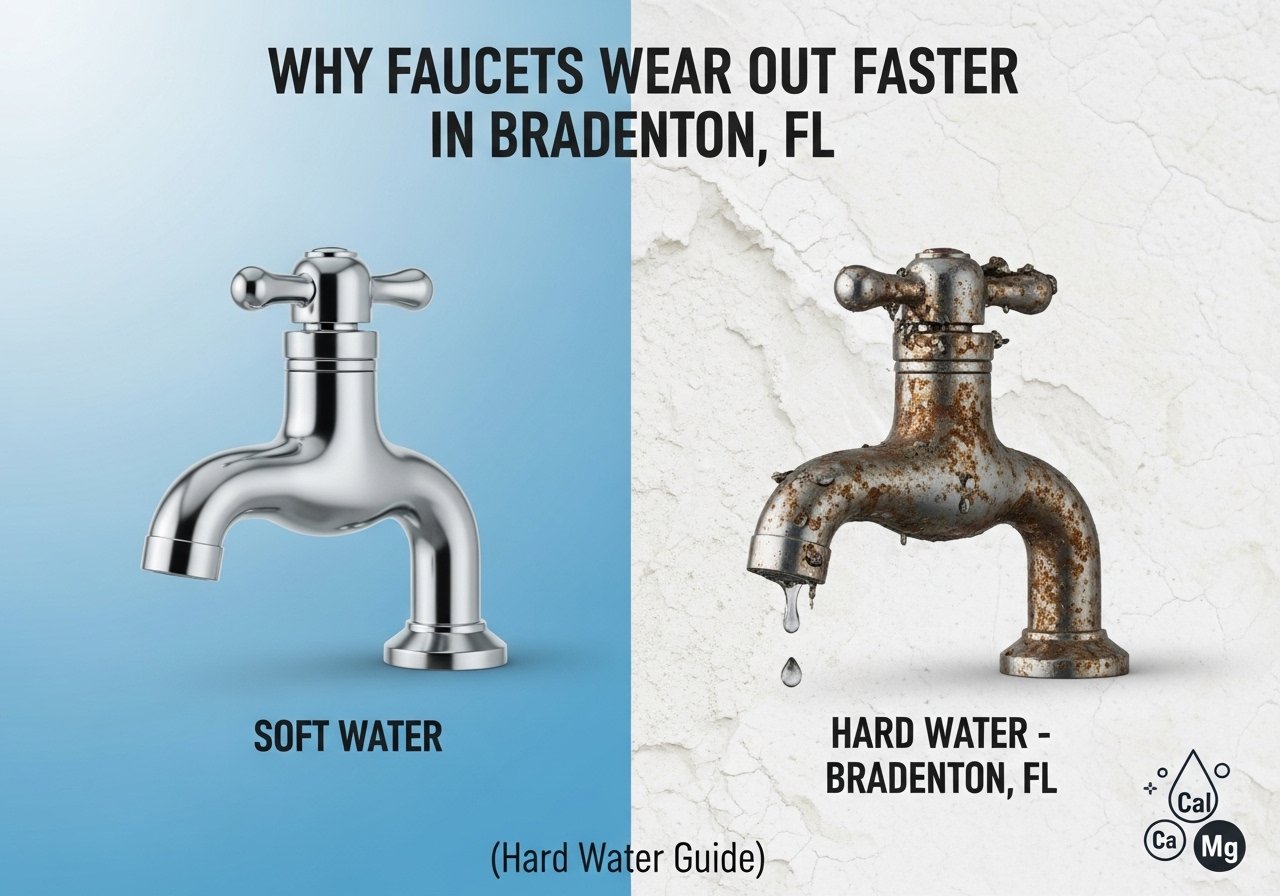
If you live in Bradenton, Florida, you have probably noticed it before — the white crusty buildup around your faucet base, the drip that started small and never stopped, or the handle that gradually became harder to turn. You replaced the fixture not long ago, yet here you are again dealing with the same problems. You are not imagining it, and you are not buying cheap faucets. The real culprit is the water flowing through your pipes every single day.
Bradenton sits on top of one of Florida’s most mineral-rich aquifer systems. The groundwater that feeds the local municipal supply travels through layers of limestone and dolomite before it ever reaches your tap, and it carries a heavy load of dissolved calcium and magnesium along the way. That combination — known as hard water — does not just leave spots on your dishes. It quietly and relentlessly attacks every faucet, valve, and fixture in your home, cutting their useful life down significantly compared to homes in soft-water regions.
This guide explains exactly how that process works, what warning signs to watch for, and how Bradenton homeowners can slow the damage before a minor nuisance turns into a costly plumbing repair.
What “Hard Water” Actually Means for Your Home
Water hardness is measured in grains per gallon (GPG) or milligrams per liter (mg/L). Water below 1 GPG is considered soft. Anything above 7 GPG is classified as hard, and above 10.5 GPG is very hard.
Bradenton’s municipal water regularly tests in the hard to very hard range, driven by the naturally occurring calcium carbonate and magnesium sulfate that dissolve into groundwater as it moves through the region’s limestone geology. Unlike some water quality concerns, hardness is not a health risk — but it is an equipment killer.
When hard water heats up, slows down, or evaporates, the dissolved minerals crystallize and form scale. That scale accumulates anywhere water sits or flows repeatedly: inside aerator screens, around cartridge seals, on valve seats, inside supply line fittings, and along the interior walls of your faucet body. Over months and years, that buildup is what causes faucets in Bradenton to fail far sooner than the manufacturer’s warranty suggests they should.
The 6 Ways Hard Water Destroys Faucets Faster in Bradenton
1. Aerator Clogging — The First Sign Most Homeowners Notice
The aerator is the small threaded cap at the tip of your faucet spout. Inside it sits a fine mesh screen that mixes air into the water stream to reduce splashing and improve flow efficiency. It is also the first place hard water mineral deposits accumulate.
In Bradenton, the calcium load in the water supply can clog an aerator’s mesh screen in as little as three to six months, depending on your water usage habits. As scale builds up on the mesh, flow becomes restricted. You might notice the stream becoming uneven, weaker, or spraying sideways rather than falling straight. Many homeowners mistake this for a pressure problem somewhere deeper in the plumbing, when in reality the fix is as simple as unscrewing the aerator tip and cleaning or replacing the screen.
Left unaddressed, a clogged aerator forces your faucet body to work under slightly elevated back-pressure, which accelerates wear on internal seals and cartridges. What starts as a $3 aerator problem can quietly shorten the life of a $200 fixture.
2. Cartridge Failure — The Most Expensive Hard Water Consequence
Modern single-handle faucets use a cartridge — a self-contained valve mechanism — to control both water flow and temperature. Cartridges are precision-engineered components with tight tolerances between their moving ceramic or plastic discs.
Hard water mineral deposits do not respect those tolerances. As calcium and magnesium crystals form inside the cartridge housing, they create micro-abrasion between the disc surfaces and pack into the gaps that normally allow smooth movement. The result is a faucet that drips even when fully closed, becomes progressively harder to turn, or loses the ability to maintain consistent temperature.
Cartridges in soft-water regions often last eight to twelve years. In hard-water areas like Bradenton, it is common for homeowners to need cartridge replacement every three to five years — sometimes sooner in heavy-use fixtures like kitchen faucets. Our team at Faucet Repair & Installation in Bradenton, FL sees accelerated cartridge failure regularly and stocks cartridges for all major faucet brands to handle same-day replacements.
3. O-Ring and Seal Degradation
Every faucet contains multiple rubber or silicone O-rings that form watertight seals around the cartridge, the spout base, and the supply line connections. These O-rings are designed to flex and compress repeatedly over thousands of on-off cycles.
Hard water introduces two threats to O-rings that soft water does not. First, mineral-laden water with elevated pH levels causes rubber compounds to stiffen and become brittle faster than they would in neutral or soft water. Second, scale deposits form rough, jagged surfaces around the O-ring seats — essentially creating sandpaper that grinds against the rubber each time you turn the handle.
The outcome is leaks at the spout base, around the handle, or beneath the sink where supply lines connect — all of which can go unnoticed for weeks in a cabinet under the sink. If you have experienced soft cabinetry, a musty odor near your vanity, or unexplained water staining inside the cabinet, a failed O-ring is often the culprit. Issues like these are exactly why professional leak detection in Bradenton is worth scheduling before the damage spreads to your subfloor or walls.
4. Valve Seat Corrosion
Inside a faucet, the valve seat is the contact point between the movable washer or cartridge disc and the fixed housing. Each time you use the faucet, the valve seat experiences direct contact pressure. In normal circumstances, the seat wears very slowly.
Hard water accelerates valve seat corrosion in two ways. Calcium and magnesium deposits form on the seat surface, creating an uneven contact area that causes the washer to wear unevenly and fail to seal completely. Additionally, the slightly elevated mineral content in Bradenton’s water can promote galvanic corrosion on metal valve seats, particularly in older fixtures with brass or chrome-plated components.
A corroded valve seat is one of the most common causes of a persistent drip that returns shortly after a washer replacement — because replacing the washer does not address the rough, pitted seat it is pressing against.
5. Finish Deterioration from Mineral Deposits and Coastal Humidity
Bradenton’s location on Florida’s Gulf Coast adds a second environmental stressor on top of hard water: salt-laden humid air. Faucet finishes — whether polished chrome, brushed nickel, oil-rubbed bronze, or matte black — are engineered to resist normal moisture exposure. They are not engineered for the combination of salt air humidity and repeated hard water mineral deposits.
Calcium and magnesium deposits left on the fixture surface after water evaporates are mildly alkaline and abrasive. Scrubbing them off with common household cleaners often does more damage than the deposits themselves, as many cleaners that dissolve mineral scale also strip protective finish coatings. Over time, the finish pits, tarnishes, or develops permanent staining that cannot be removed without damaging the underlying metal.
Once the finish breaks down, the bare metal underneath is exposed to both moisture and minerals, and corrosion accelerates rapidly. Fixtures that should last fifteen or more years in favorable conditions may look and function like they are at end-of-life within five to seven years in Bradenton without proper maintenance.
6. Supply Line and Connection Fitting Scale Buildup
Hard water damage does not stop at the faucet body itself. The braided supply lines connecting your shut-off valves to the faucet inlet ports, and the compression fittings at each connection point, are also subject to mineral accumulation.
Scale that forms inside supply line fittings gradually reduces interior diameter and restricts flow. More critically, mineral deposits can cause compression fittings to seize — making future shut-off valve operation or faucet removal extremely difficult without damaging the fitting or the valve itself. In severe cases, disturbing a heavily scaled fitting can cause it to crack or fail, turning a simple faucet replacement into a more involved pipe repair situation under the sink.
Warning Signs Your Faucet Is Losing the Battle Against Hard Water
Knowing what to look for helps you catch problems before they compound. Watch for these indicators in your Bradenton home:
White or yellowish crust at the faucet base or spout tip — This is calcium carbonate scale, and it is the most visible sign that hard water is actively depositing minerals on your fixture. Even if the faucet still functions normally, this crust indicates the same buildup is occurring inside.
Reduced water pressure from a single faucet — If one faucet has noticeably weaker flow than others in the house, a clogged aerator is almost certainly the cause. This is a quick fix but should not be ignored.
A drip that never fully stops — A faucet that drips even when the handle is fully closed has either a worn cartridge, a degraded O-ring, or a corroded valve seat. A single dripping faucet can waste more than 3,000 gallons of water per year — a number that adds up quickly on a tiered Bradenton water bill.
Handles that have become stiff or difficult to turn — Mineral buildup inside the cartridge mechanism restricts movement. This is an early warning sign of cartridge failure that will eventually result in a full drip or inability to control temperature.
Discoloration inside the cabinet under the sink — Water staining, soft wood, or a musty odor under the sink suggests a slow leak at the supply line connection or faucet base seal. These hidden leaks can go undetected for months and cause significant structural damage.
Rust-colored or brown water from the faucet — While this can have multiple causes, one common source is the corrosion of internal metal components accelerated by mineral-rich water. If you notice discolored water, our leak detection and repair team can help trace whether the source is the faucet itself or something deeper in the supply line.
How Hard Water Affects the Rest of Your Plumbing System
Faucets are the most visible victim of Bradenton’s hard water, but they are far from the only one. The same mineral buildup that shortens faucet life accumulates throughout your entire plumbing system.
Your water heater is particularly vulnerable. Scale deposits on the heating element and tank interior act as insulation, forcing the unit to work harder and longer to heat the same volume of water. Over time, this dramatically reduces energy efficiency and shortens the heater’s service life. If your water heater is making a popping or rumbling noise during heating cycles, that sound is often trapped water boiling beneath a layer of accumulated scale. Our water heater services team in Bradenton regularly services units where scale buildup has become the primary source of performance degradation.
Shower and bathtub fixtures face the same cartridge and O-ring wear described above, compounded by the higher water volume and temperature fluctuations of daily bathing. Showerheads accumulate scale inside their nozzle holes, producing uneven spray patterns and reduced flow. Drain components can also accumulate mineral deposits that combine with soap residue and hair to create stubborn clogs — which is why professional drain cleaning in Bradenton is a more common need here than in soft-water regions.
Even your dishwasher and washing machine supply valves are affected. Any valve that opens and closes repeatedly in hard water will experience accelerated wear on its internal seals.
Practical Steps Bradenton Homeowners Can Take Right Now
You cannot change the chemistry of your municipal water supply, but you can take steps to reduce the damage it does inside your home.
Clean aerators every three to six months. This is the single most effective maintenance step for Bradenton faucets. Unscrew the aerator tip, soak it in white vinegar for thirty minutes, rinse thoroughly, and reinstall. Replace it outright if the mesh is damaged or the housing is cracked.
Use a descaling solution on visible fixture scale. A diluted white vinegar solution applied with a cloth and left for fifteen to thirty minutes will dissolve calcium deposits on faucet exteriors without damaging most finishes. Avoid abrasive scrubbers, which scratch protective coatings. Avoid harsh commercial descalers on finished surfaces unless the product is explicitly listed as safe for your specific fixture finish.
Choose faucets with ceramic disc cartridges for new installations. Ceramic disc cartridges outperform traditional ball-valve and rubber-washer designs in hard water because ceramic does not degrade from mineral contact the way softer materials do. Look for WaterSense-certified models with PVD (Physical Vapor Deposition) finishes, which resist mineral staining and salt air corrosion far better than standard chrome.
Consider a whole-home water softener. A water softener removes calcium and magnesium ions from your water supply through an ion-exchange process, replacing them with sodium ions. Softened water dramatically reduces mineral scaling throughout your entire plumbing system — extending the life of faucets, water heaters, and appliances simultaneously. If a whole-home system is not feasible, point-of-use filters at kitchen and bathroom faucets offer partial protection for the most heavily used fixtures.
Do not ignore small drips. A dripping faucet in Bradenton is not just a nuisance — it is a symptom of internal component wear that will progress. The longer a worn cartridge or O-ring operates, the more it damages the surrounding components it contacts, turning a simple cartridge replacement into a full fixture overhaul.
Schedule annual plumbing inspections. A qualified plumber can catch early signs of mineral-related wear — scaling inside supply line fittings, early cartridge wear, valve seat corrosion — before they escalate into failures that require emergency repairs. Our team at Redemption Plumbing Services offers expert faucet repair and installation in Bradenton for homeowners across Manatee County who want to stay ahead of hard water damage rather than react to it.
When to Repair vs. Replace Your Faucet
This is a question we hear frequently from Bradenton homeowners, and the honest answer depends on the age and condition of the fixture.
Repair makes sense when the faucet is less than five years old, the body and finish are in good condition, the drip or pressure issue is isolated to a specific component (aerator, cartridge, or O-ring), and the replacement parts are readily available for your brand and model.
Replacement makes more sense when the fixture is more than seven to ten years old and has already had one or more repairs, the finish has deteriorated beyond cosmetic recovery, multiple components are failing simultaneously, or the faucet is an older model with a design that does not accommodate modern hard-water-resistant cartridges.
In Bradenton’s hard water environment, a well-chosen replacement faucet with a ceramic disc cartridge and PVD finish will often outlast a repaired older fixture by several years — and cost less in total maintenance over that period.
Protect Your Bradenton Faucets Before the Next Drip Starts
Hard water is a permanent feature of life in Bradenton, but premature faucet failure does not have to be. Understanding how mineral deposits attack your fixtures from the inside out — and taking targeted steps to counter that process — can add years to the life of every faucet in your home.
If you are already dealing with a persistent drip, reduced flow, stiff handles, or visible mineral buildup, the team at Redemption Plumbing Services handles faucet repair and installation across Bradenton and Manatee County with same-day service available for most faucet issues. From aerator cleaning to full fixture replacement, we carry the parts and experience to get your water flowing right — and keep it that way longer than Bradenton’s hard water would prefer.
Call (941) 541-7473 or schedule your appointment online to get started.

Comments are closed