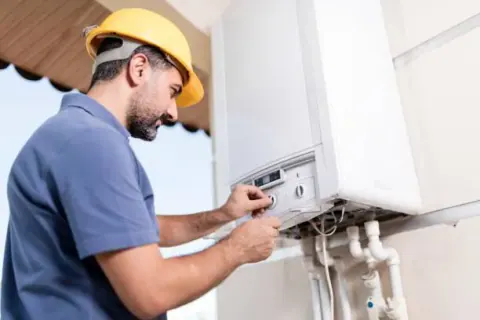
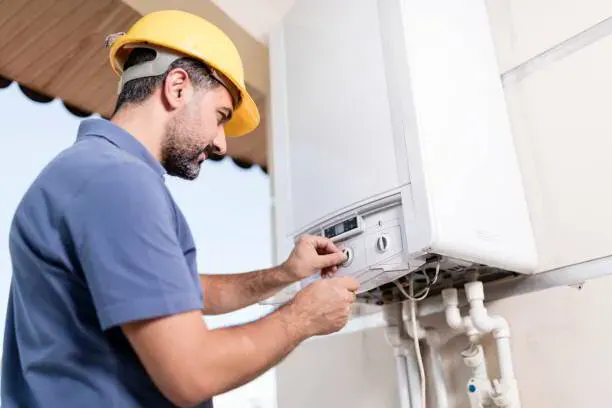
Learning how to choose the right water heater usually happens at the worst possible moment: the old one is leaking and you need hot water tomorrow. If you have a little time, a few questions in the right order will get you to a unit that fits your household instead of simply matching whatever was in the closet before.
This guide works through those questions one at a time. It is a general framework; if you are weighing just two options, our articles on tankless versus traditional heaters and the Bradenton tank-or-tankless decision go deeper on that comparison.
Question 1: How Much Hot Water Do You Use at Once?
Sizing is about your busiest moment, not your daily average. Think about a weekday morning: two showers running, the dishwasher going, maybe a load of laundry. That peak is what the heater has to keep up with.
- Tank heaters are compared by their first-hour rating, which is how much hot water they can deliver in an hour starting full. Match it to your morning rush, not just the tank's gallon size.
- Tankless heaters are compared by flow rate at a given temperature rise. Add up the fixtures you realistically run at the same time and size for that.
- Larger households, big soaking tubs and multi-head showers push the requirement up quickly.
Florida's incoming water is warmer than in northern states, so a tankless unit has less temperature to add. That helps, but it does not replace a proper sizing calculation.
Question 2: What Fuel Does Your Home Have?
Many homes in our area are all-electric, and others have natural gas or propane. Staying with your existing fuel is usually the simplest and least disruptive path. Switching is possible, but it may involve new gas piping and venting, or a dedicated electrical circuit with enough capacity, so it should be priced as part of the project.
Gas units generally recover faster. Electric units are simpler to vent and install. Neither is automatically better; the right choice depends on what your home already supports and how you use hot water.
Question 3: Which Type Fits Your Priorities?
There are three common options, and each trades upfront cost against operating cost and space differently:
- Conventional tank: lowest upfront cost and simple to replace like-for-like. It keeps a reservoir hot all day, so some energy is lost while it sits.
- Tankless: heats on demand and does not run out of hot water within its flow limit. It costs more to install and needs regular descaling where water is hard.
- Heat pump (hybrid) tank: pulls heat from the surrounding air, so it is very efficient in a warm climate. It needs room around it for airflow, makes some fan noise and cools the space it sits in, which suits a garage better than a small interior closet.
Measure the space before you shop. Note the height, width and door clearance of the closet or garage spot, and where the drain pan and expansion tank sit. Many 'upgrade' plans change once the measurements are on paper.
It also helps to think about time horizon. If you plan to stay in the home for many years, a higher-efficiency unit has longer to pay back its extra upfront cost through lower operating bills. If you expect to sell soon, a reliable, correctly sized conventional tank may be the more sensible spend.
Finally, consider how your household actually uses hot water. Families who shower back to back benefit from strong recovery or on-demand heating, while a couple who rarely runs two fixtures at once can often do well with a smaller, simpler unit.
Question 4: What Does Your Space Allow?
Location shapes the choice more than most people expect. An interior closet limits tank size and rules out most heat pump units. A garage gives more flexibility. Tankless gas models need a proper venting route, and some electric tankless units need significant electrical capacity.
Safety items come with any installation: a correctly sized temperature-and-pressure relief valve and discharge line, a drain pan where water could damage the floor, and an expansion tank where the plumbing system calls for one. These are part of a proper job, not optional extras.
Question 5: How Will You Handle Hard Water?
Much of Southwest Florida has hard water, and the minerals settle as scale. In a tank, scale collects on the bottom and around elements, making the unit work harder and shortening its life. In a tankless heater, scale coats the heat exchanger and reduces performance. Our article on how hard water wears out heaters early explains the process.
Whatever you choose, plan for upkeep: periodic tank flushing and anode checks for tank models, and regular descaling for tankless units. A heater that is maintained will almost always outlast an identical one that is ignored.
Putting It Together and Getting a Quote
Once you know your peak demand, fuel, preferred type, space limits and maintenance plan, the right size and model usually narrows to a short list. A licensed plumber can confirm the sizing, check venting and electrical needs, and point out any code-related corrections the old installation needs.
Redemption Plumbing services, repairs and installs tank and tankless water heaters from all major brands. Call (941) 541-7473 for a free phone estimate with upfront pricing, and ask about financing for qualifying installations. If your current heater has already failed, our water heater services team can help you decide quickly without guessing.