Most homes have used a storage tank water heater for generations, and tankless models have spent years being marketed as the modern replacement. The truth sits in between. Comparing tankless vs traditional water heaters fairly means understanding how each one actually heats water, because nearly every advantage and drawback follows from that design.
This article is a general explainer. If you live in Manatee County and want help applying it to your own house, our Bradenton tankless vs tank decision guide covers local issues like hard water and electrical capacity.
How a Traditional Tank Water Heater Works
A traditional heater stores a fixed volume of water in an insulated tank and keeps it at a set temperature around the clock. Electric models use heating elements inside the tank; gas models use a burner underneath. When you open a hot tap, hot water leaves from the top while cold water enters near the bottom through a dip tube and starts heating.
Because the water is already hot, a tank can supply several fixtures at once with strong flow. The tradeoff is that once the stored hot water is used, you wait for the tank to recover. And because the tank holds heat all day, it slowly loses some to the surrounding air. That loss is called standby heat loss, and it is the main efficiency penalty of the design.
How a Tankless Water Heater Works
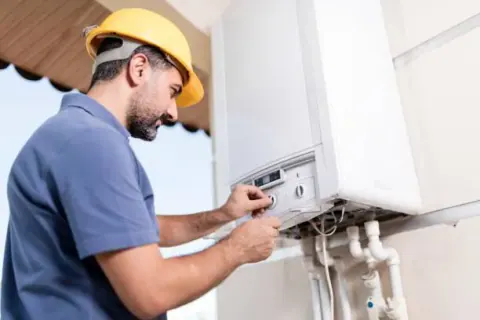
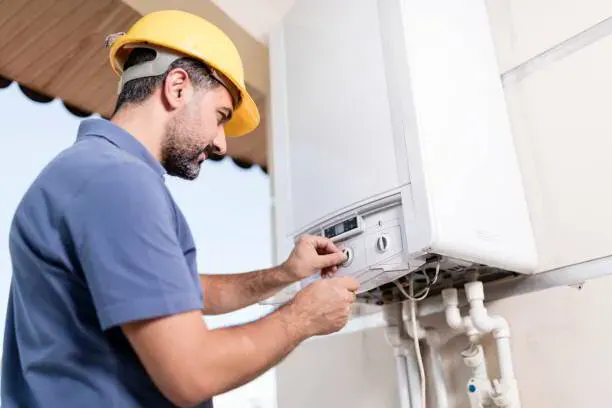
A tankless heater stores almost no water. When a flow sensor detects a hot tap opening, the unit fires a gas burner or powerful electric elements and heats water as it passes through a heat exchanger. When the tap closes, it shuts down.
Most units also need a minimum flow before they fire, so a barely open hot tap may deliver cool water. That is rarely a problem for showers or appliances, but it is worth knowing if you like to rinse dishes under a trickle.
That means no standby loss and, as long as demand stays within the unit's capacity, no running out. The key limit is flow rate: each unit can raise the temperature of only so many gallons per minute. Ask it to supply three showers and a washing machine at once and the water may cool or the flow may drop. Sizing a tankless unit correctly to your home's peak demand is essential.
Head-to-Head: Where Each One Wins
Where tank heaters come out ahead
- Lower upfront cost and simpler replacement, since existing connections can usually be reused
- Strong simultaneous flow to several fixtures from stored water
- Simple, familiar technology that most plumbers service routinely
- No minimum flow needed to start heating, so a trickle of hot water still arrives
Where tankless heaters come out ahead
- No standby heat loss, which can lower operating cost, especially in light-use homes
- Continuous hot water within the unit's flow capacity
- Compact, wall-mounted design that frees floor space
- Often a longer service life when descaled and maintained on schedule
Common Myths Worth Setting Aside
Myth: tankless means instant hot water at the tap. The heater warms water instantly, but the water still has to travel through the pipes to reach you. Fixtures far from the heater wait just as long as before unless a recirculation system or a point-of-use unit is added.
Myth: a tankless heater never runs out, no matter what. It never runs out within its flow limit. Exceed that limit and the temperature drops. Correct sizing solves this; an undersized unit makes it a daily annoyance.
Myth: tanks are always wasteful. A modern, well-insulated tank set to a sensible temperature in a busy household can be a reasonable choice. Efficiency depends on how the heater is used, not only on its type.
If you notice a brief burst of cold water partway through a hot shower on a tankless system, that is often called a cold water sandwich. It happens when someone turns the water off and back on quickly, and it is normal for many units.
Maintenance and Lifespan
Both types last longer with care, and both suffer in areas with mineral-rich water. Tanks should be flushed periodically to remove sediment, and the anode rod that protects the tank lining from corrosion should be checked and replaced when it is used up. The temperature and pressure relief valve should also be tested.
Tankless units need their heat exchanger descaled, inlet filters cleaned and, for gas models, venting and combustion checked. Skipping descaling is the most common reason a tankless unit underperforms. Our water heater maintenance guide for Manatee and Sarasota gives a step-by-step routine for both types.
Choosing the Right One for Your Home
A simple way to decide is to answer four questions: How much do you want to spend now versus over the next decade? How many hot fixtures run at the same time in your busiest hour? Can your gas line or electrical service support a tankless unit without major upgrades? And are you willing to keep up with scheduled descaling?
It also helps to think about timing. Replacing a heater on your own schedule, before the old one fails, gives you room to compare options, confirm sizing and plan any gas or electrical work. Replacing it the day it floods the garage usually means choosing whatever restores hot water fastest, which is most often a like-for-like tank.
We service, repair and install both tank and tankless water heaters from all major brands, so we can lay out the options honestly. Call (941) 541-7473 for a free phone estimate with upfront pricing, and ask about financing for qualifying installations. You can also read more on our water heater services page.