Ask three people about trenchless repair and you may hear that it is a miracle, a gimmick or simply the way everything is done now. None of those is quite right. The comparison between trenchless pipe repair vs traditional replacement is really about matching a method to a specific kind of damage, then weighing what each method costs you in disruption, restoration and long-term performance.
This explainer covers how each approach works, the problems each one is best at solving and the questions that decide between them. If you are a Bradenton homeowner weighing a real project, our local trenchless vs traditional decision guide applies these ideas to yards, driveways and slabs in the area.
Three Ways to Fix a Damaged Pipe
Traditional open-trench replacement
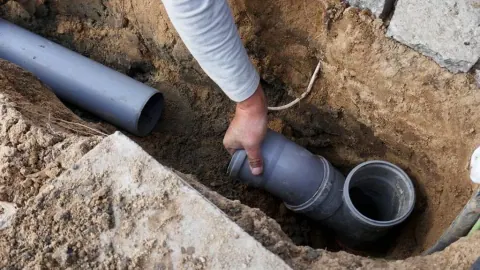
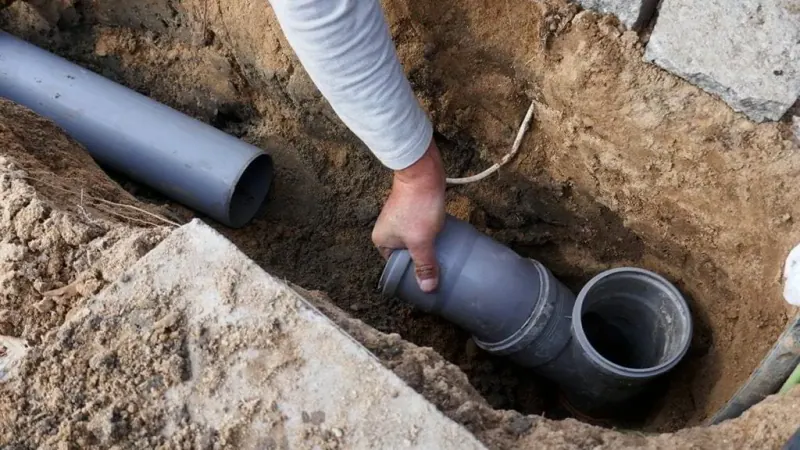
The damaged pipe is exposed by excavation, removed and replaced with new pipe laid at the correct slope, then the trench is backfilled and the surface restored. It is the oldest method, and it can correct almost any problem because the plumber has direct access to everything.
Pipe lining
Often called cured-in-place pipe, lining inserts a flexible tube saturated with resin into the existing pipe. The liner is pressed against the old pipe wall and cured until it hardens into a seamless new pipe inside the old one. The host pipe stays in the ground and acts as a form.
Pipe bursting
A cone-shaped bursting head is pulled through the old pipe from one access pit to another. It fractures the old pipe outward while drawing a new, continuous pipe in behind it. Unlike lining, bursting can install a pipe of the same or sometimes larger diameter.
Matching the Method to the Damage
The type of damage, more than anything else, determines which method makes sense. A camera inspection is the only reliable way to know which category your pipe falls into.
- Cracks, pinholes and root entry at joints in a pipe that still holds its shape: lining is often an excellent fit.
- Heavy internal corrosion or scale in older metal pipe: lining after thorough cleaning can work if the pipe is still structurally intact.
- A pipe that is undersized or badly deteriorated along its length: bursting can replace it with new pipe along the same path.
- A collapsed section, severe sag or wrong slope: traditional excavation is usually required, at least for that section.
- A single short break in an easy-to-reach spot: a traditional spot repair may be the simplest answer.
Repair and replacement are not all-or-nothing. Many projects combine a short excavation to correct one bad section with lining or bursting for the rest of the line.
How the Methods Compare
- Disruption: trenchless methods need only small access points; traditional replacement opens the full length of the work.
- Restoration: trenchless leaves lawns, driveways and floors largely intact; traditional work includes rebuilding whatever was over the pipe.
- Slope and alignment: only excavation can fully correct a pipe laid at the wrong grade; lining follows the existing path, and bursting largely does too.
- Pipe diameter: lining slightly reduces the inside diameter; bursting and traditional replacement can maintain or increase it.
- Branch connections: lining requires reopening side connections from the inside; traditional work reconnects them directly.
Durability and Long-Term Performance
A properly installed liner or burst pipe is designed for long service, and modern materials resist the root intrusion and corrosion that ruined the original pipe. New pipe laid in a trench is equally durable. In practice, longevity depends more on correct diagnosis, preparation and installation than on the method itself.
Material choices matter too. Traditional replacement typically uses modern plastic pipe, which resists corrosion and root entry at properly made joints. Lining resins and liners are engineered for the conditions inside drain and sewer pipes, and bursting usually pulls in a continuous length of plastic pipe with few or no joints at all. Ask what material will be installed and why it suits your line.
That is why the most important step happens before any repair: cleaning the line, often with hydro jetting, and inspecting it with a camera. A liner installed over debris, or a burst pipe pulled through a line with an unknown sag, can underperform no matter how good the materials are.
When Traditional Replacement Is Still the Right Call
Trenchless technology has not made excavation obsolete. Traditional replacement remains the better choice when:
- The line has collapsed and nothing can pass through it.
- A sag or misalignment is causing repeated backups and must be physically corrected.
- The pipe route needs to change, for example to move a line away from a new structure.
- The damaged section is short, shallow and under open ground, where digging is quick and restoration is minimal.
A plumber who offers both methods has no reason to push one over the other. We provide trenchless pipe lining and pipe bursting as well as conventional repairs, so the recommendation follows the camera footage.
Questions to Ask Before You Decide
- Can I see the inspection footage and the marked locations of each defect?
- Is the recommendation for the whole line or one section, and what condition is the rest in?
- How will the line be cleaned before lining or bursting?
- What restoration is included, and what is not?
- How will the finished work be verified?
To talk through a damaged line, call Redemption Plumbing at (941) 541-7473 for a free phone estimate with upfront pricing, and ask about financing for qualifying larger jobs. You can also explore our trenchless pipe repair services or our pipe repair and replacement options.