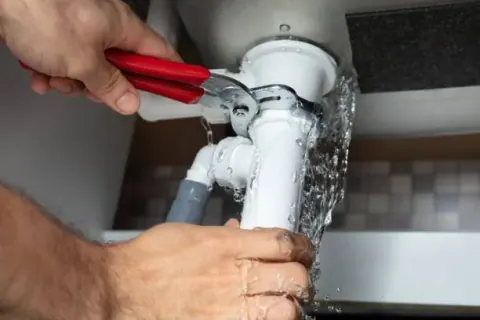

Most homeowners call a plumber after they already know something is wrong: a stain, a warm floor, a meter that won't stop moving. The question then becomes where the water is coming from. Professional pipe leak detection in Manatee County is the step that answers that question before anyone picks up a saw or a jackhammer.
It can be tempting to skip it and start opening the wall where the stain is. But water travels along pipes, studs and the top of a slab, so the stain is often feet away from the actual failure. Below are the practical advantages of locating the leak properly first, and what the process looks like when we do it.
Advantage 1: Smaller, Targeted Openings
The biggest cost in many leak repairs isn't the pipe. It's the drywall, tile, flooring and cabinetry that have to be removed and restored to reach it. Leak detection tools let a technician narrow the source to a small area, so the opening is sized to the problem instead of to a hunch.
That matters in a lot of Manatee County homes, where slab foundations, tile floors and finished garages leave little room for exploratory demolition. One accurate opening is almost always cheaper, faster and less disruptive than three guesses.
Advantage 2: Confirming It Is Really a Plumbing Leak
Not every wet spot is a pipe. In our humid climate, condensation from an air conditioning line, a sweating cold-water pipe, a roof or window leak, or old staining can look a lot like an active plumbing leak. A professional starts by confirming whether water is actually escaping the plumbing system.
- Checking the water meter with every fixture off to see whether water loss is active
- Isolating fixtures and branches to see which part of the system is losing water
- Testing pressure to tell a supply-side leak from a drain-side one
- Ruling out condensation and outside water sources before any opening is made
If the meter is still and the spot keeps getting wet, the source may not be plumbing at all, and you've just avoided paying to open a wall that didn't need opening.
Advantage 3: Finding Leaks You Can't See or Hear
Some of the most damaging leaks give almost no surface clue. A pinhole in a supply line under the slab can seep into the sandy ground for weeks. A drain line leaking inside a wall may only show when one particular shower runs. Specialized equipment, along with a methodical process, picks up what eyes and ears miss.
For drains and sewer lines, a sewer camera inspection shows cracks, separated joints and root intrusion from the inside. For pressurized supply lines, dedicated leak detection narrows the search to the most likely spot before access begins.
Before your appointment, write down when you first noticed the problem, any recent jump in your water bill, and whether the symptom changes when a specific fixture runs. That timeline often shortens the search considerably.
Advantage 4: Better Repair Decisions
Knowing the exact location and cause changes the repair conversation. A single failed fitting may call for a simple spot repair. A line with repeated pinholes may be better rerouted or replaced. A drain line with multiple defects might be a candidate for trenchless pipe lining instead of excavation.
Without detection, you're choosing a repair based on partial information. With it, you can compare options with a clear picture of the pipe's condition, and you'll know the price before work starts.
Advantage 5: Documentation and Verification
A professional visit produces a record of what was found and where. That documentation is helpful if you file an insurance claim, sell the home or need to explain the repair to a landlord or HOA. Photos, camera footage and notes are much stronger than a description from memory.
Just as important, the job doesn't end at the repair. We recheck the system afterward, typically by watching the meter with all fixtures off, so you know the leak is fixed and not just moved.
That final check is the difference between a repair and a resolution. Older homes in particular can have more than one weak point, and a second, smaller leak is easy to miss if nobody verifies the system afterward. Catching it on the same visit saves you a repeat of the whole process a month later.
What a Visit Looks Like
- Describe the symptom. Call (941) 541-7473 and share what you're seeing, when it started and any meter or bill clues. We'll give a free phone estimate.
- Confirm and isolate. The plumber checks the meter, isolates fixtures and determines whether the leak is in the yard line, inside the house or under the slab.
- Pinpoint and explain. Equipment narrows the location, then you get a clear explanation of the access needed and the repair options, with upfront pricing.
- Repair and recheck. Approved work is completed, and the system is tested again to confirm it holds.
If you want to understand the warning signs before you call, our guide to spotting a hidden leak early is a good place to start.